
Friday, February 20, 2015
Linguistic Self-Consistency

The American self-consistent bragging is a sort of self-addressed love song. They look like they are describing themselves to other people, but really they are talking to someone hidden within themselves. By this device, they make themselves feel their imaginary friend's love. On the other hand since it is well known that people the world over like humility, the Japanese are merely representing themselves in a perfectly natural, pleasant way.
Hand the subjects a camera, however, and suddenly the ghost that haunts the Japanese psyche becomes apparent, from their utra-cute selfie behaviour. It is through this comparison, I hope, we shall have her out into the light of day. Got it!
Image adapted from Table 6, p99 in Kanagawa, Cross, & Markus, (2001). Kanagawa, C., Cross, S. E., & Markus, H. R. (2001). ‘Who am I?’ The cultural psychology of the conceptual self. Personality and Social Psychology Bulletin, 27(1), 90–103. http://flic.kr/p/rgNvAX
Labels: autoscopy, blogger, Flickr, japanese culture, nihonbunka, 日本文化


Monday, February 16, 2015
cleanliness

Labels: blogger, Flickr, japaneseculturenihonbunka日本文化
Thursday, February 12, 2015
No Other of the Japanese Self? Mori, Arimasa, Kawai and Nishida

Mori Arimasa (1911 - 1976), was the grandson of Meiji period statesman Mori Arinori. His father was a Christian priest. A Christian himself, he relocated to France in 1950 where he remained until his death. He was an accomplished organ player and fluent in French and Latin. It seems to me that he understood European's better than they they themselves.
Mori was quite critical of his own country being one of several commentators (Kawai, 1977; Kishida, 1993) who believe that the Japanese self lacks an intra-psychic (in ones head) other that might provide it with a "pivot" to leverage itself out of face to face, first-second person, social relationships.
Mori believed this "pivot" (p.230) was provided in France by the French language. Mori saw a commonality or nexus, an inter-linkage, between reality, science, language and 'the unknowable existence' by which he referred to his own, Christian, God (to whom, presumably, he addressed himself linguistically).
The connection between God and science is particularly interesting and one which I have been persuaded by some research by Ma-Kellams (2013), to be introduced further down.
Mori living in Paris in the 1960s I feel was influenced by Lacanian psychology as well as by his own religion. Expressed in Kawai's diagram above lower half (Kawai, 1977, p153), Mori felt that Westerners had constructed an other, within their culture, society and themselves, to which their ego had achieved independence from out of binary experience. This other for Mori was God, Science and above all language. He felt that the French language provided a pivot, structure, or framework within which the ego or, first person, of the francophone attains independence as a third person. As Lacan says, the unconscious in the West, is structured like a language. It is language, made flesh.
Mori contrasts this with the Japanese case in which he claimed that the Japanese first person, expressing itself in various levels of polite, humble, honorific language was always embedded in the lived experience which defined a hierarchical binary pair. When Japanese meet face to face and speak one of them will adopted the dominant, the other subservient position, and their self be defined by that relationships such that their "I" ego is no more, no less than a "you" for the "you" that they are speaking to. His most famous theory has it that the Japanese "I" is "You for you" (汝の汝). Francophone's however are not trapped within immediate experiences in this way. This allows them, he claims, to address broader social issues rather than that which is in front of their noses. Lacking a self, the Japanese also lack, Mori claims, a sense or concern for society, a collection of selves.
Kawai likewise, in the diagram above (1977, p153), believed that while Europeans had carved out of the morass of their unconscious an area of rationality occupied by the ego, the Japanese, or East Asian, self was still more at one with the unconscious. The lack of a developed self, however, no doubt appealed to the Buddhist element within Kawaii's readership who believed in their Buddha nature, the Eastern conception of God. Under this conception, Westerners have an independent self in relation to Yahweh. Easterners are like children, lacking a self but being closer to the 'purity of their experience' which they regard as divine.
Kishida (1993) likewise argues that the equivalent term that anchors the Japanese self is not God, or some intra-psychic other, but other people. Pointing out that social phobia (対人恐怖症) is particularly prevalent among the Japanese, he denies that it has no equivalent in the West. The equivalent term among Westerners is he says, "fear of God" (対神恐怖) or guilt since it is in relationship with their internalised other - God - that Westerners create themselves and maintain their sense of self-esteem, whereas it is in relation to real others that the Japanese self is created. I suggest that the Western equivalent of social phobia (which Westerners now seem to suffer from) is, rather than the fear of gazes, blushing, and sweating and all the other visual symptoms that typify Japanese psycho-pathology but paranoid personality disorder typified by conspiracy theories, and belief that others are saying and thinking (in words) bad things about oneself. Both disorders may be related to a break down in intra-psychic self-other (ego to super-ego, self to impartial spectator, self to generalised other, face to mirror-in-the-head) relationships, accompanied by excessive reliance on, and subsequent dissatisfaction with social relationships for the maintenance of verbal and visual self-esteem and self.
Mori's theory of the "You for you" may also owe a lot to Nishida Kitarou's philosophy and particularly the short essay on "I and You" in which he discusses the social construction of self as acting agent. Like Mori, NIshida argues that Westerners have always privileged the self as knowledge or knower and sense as at best a object of the knowing subject. He claimed that the acting experiencing subject is however possible and lived in Japan by the Japanese whose self is constructed through their acts, which are observed by others. The Japanese self achieves its existence as an I for the community.
It would seem (at least in the Nishida that I have read thus far) that he did not posit the same sort of unity to Japanese community that Mori felt was embodied by the language- science-God nexus that haunts the West. In Nishida's Zen Buddhist philosophy, acting (visual) self sees itself and others see it too, but there is no Other, no Japanese god, that saves the Japanese self from the you, society, the community. And this despite the fact that Japan is teeming with Gods.
This is where I disagree. The diagram on the right describes the Japanese self as much as it does the the Western. There may be many countries in the space between Japan and France in which the diagram on the left applies. But the Japanese have as much ego as French men, or perhaps even Americans.
In order to make a distinction it is important to note that the pivot, or other by which the ego is created is in fact, neither "impartial" nor "generalised." The former is a misconception that can be demonstrated experimentally through the fact that people in both American and Japan have tremendously inflated views of themselves. The founder of the Panasonic corporation claimed that the reason why putting things to a vote was unpopular in Japan, and the emphasis on consensus, is not because the Japanese are sheep but there are always so many big egos that would be offended if their faction lost the vote. Thus Japanese, and Americans, are not seeing themselves from the point of view of society, if they were they would evaluate themselves fairly and realistically, but from the point of view of someone within themselves who loves them. There is research in the West correlating religiosity with positive self-illusion. God, or one of the aspects of God, loves us.
I claim that the creation of an other for self, is as simple as having one imaginary friend that one has hidden and forgotten. One person who is not you, but within you. That other perspective provides enough socius, enough otherness, enough objectivity, to provide a perspective on oneself and make an object of oneself to oneself. But, further than that can be, and is a sole (not generalised) perspective and the very opposite of "impartial." As Derrida argues on the contrary, our "alter ego" to whom Westerners speak for instance, sending messages into their minds and waiting for the warm cranial kiss of approval, loves us terribly. The emphasis is perhaps on terribly. We have him or her trapped within us. There is something terrible, and taboo about our relationship with him or her, since if we able to see her we our selves, dependent as they are upon her, would be destroyed. But the other is nevertheless loving. Once the "other" of the self as understood in this way, as a sole, partial, autoscopic, visual perspective, on self it can be as effective a pivot. It is only important that she is hidden. I am thinking of Japanese horror such as Ringu and all the other Japanese horror that comes out of images, and the metaphorical words of Exodus 33:20 "you may not look directly at my face, for no one may see me and live."
The fact that the Japanese can see themselves has already been proven. The Japanese have a mirror in their heads and they have the visual positivity that always accompanies one of these internalised other self-comforting, self-creating, genesis relationships (Takemoto, forthcoming).
Finally, some recent research by Ma-Kellams (Ma-Kellams, Blascovich, 2013) knocked my socks off. I have for many years been trying to find the Japanese equivalent of the mirror to Westerners. Mirrors make Westerners Japanese. How does one make the Japanese conceive of themselves narratively, and see themselves in the mirror of language? I have tried getting Japanese subjects to record their voice and listen to it. I have tried testing their self-ideal discrepancy before and after getting them to narrate themselves in answer to twenty questions tests, and other manipulations, all to no avail.
Ma-Kellams found that getting one group of Californian subjects to make sentences from jumbled words (mat, tabby, sat, the) and the other group to make sentences about science (be, proved, to, experiment, true, hypothesis) from jumbled words, she found that the latter, the subjects that had been made to think about science became more moral. In other words, I claim, thinking about science activated the mirror of language, the strict world of scientific and generally verbal, descriptions (Bloor, 1999) that is Mori claims at the centre of Western religion, science, and language. The important thing is not to get Asians to think in language, but to get them to think in haunted language, language that has an opinion, that says yes or no: language that bites back. Science makes us aware of that language: reason personified.
I hypothesise further that there were a large number of East Asian Americans in Ma-Kellams' Californian student psychology major subject pool, but this remains to be seen. I am going to try the manipulation on Japanese. It should do something because the Japanese are generally so unscientific with language it is untrue, and in Japan, true at the same time (Peng & Nisbett, 1999).
But all this above is not to suggest that the Japanese self is not more social that that of the West. In one sense both the Japanese and Westerners have modelled society, in the form of another, 'spectator' (metaphorical or not) in their breasts, but to the Japanese that their self is interdependent, social, is always immediately apparent because the 'acting self' is seen from the outside. The perspective of the other is always notably necessary, the Japanese self, as face like "stigma"(Yang et al., 2007) is "sociosomatic", its intersubjectivity cannot be ignored. But what the Japanese appear to have forgotten is that the self can be and is manufactured both in inter-human social relationships, and in relation with their intra-psychic others: the mirrors in their hearts. This mirror can save them from other Japanese people, and pontificating Westerners like myself, both.
Speaking of mirrors, I aspire to be the mirror of Mori. Mori told the West that their God, their intra-psychic other is language. I am trying to tell the Japanese that theirs is their mirror.
Here are some Mori Arimasa quotes.
This is the diary entry where Mori states the equivalence between his pivot, language and science. "Diary entry for December 14th 1971 (Tues) Shining Day, Cold [like today in Yamaguchi]" original in French. (Mori, 1988, p479 )
フランス語は新聞の見出しのような場合でもきちんとした命題の形をとることを確認した(Japanese newspaper titles often contain sentence fragments). その意味は、命題がフランス語の本質的な形であるということだ。叙述を構成する凡ての要素が、その命題性と関連付けられて(Now I know why I hate ellipses)。鍛え上げられている。 命題は、単に、総論あるいは言語の一形態ではない。それは、人間存在の極めて厳密に限定された一様態、物事を観ずるに際しての様態なのである....(He used the wrong word there? Felt the presence of another type of 観ずる?)。主語は、関心の主語である。それに動詞の補語がある。一つの命題において、同士は肯定か否定かであり、またな何らかの相(アスペクト)と帯びる。いずれにしても、動詞は様態の作用を受けるのであり、話者としての主題がどのような態度で物事に対処しているか、すなわち、私hが進展して行きうる空間というものを示す。......(空間!space. He pauses when he mentions things Japanese, forges on again into the Western world of language. It hots up now.)。換言すれば、動詞はそれに対して下すべき判断を限定することができる。と言うことは、一言語というのは単に言語ではなく、人間の存在形態でもあるということだ。それは考察を通して限定される行動である。そしてこの考察は出来事自体のうちに入っている。日本語の場合、考察は事が起こってから後に付け加わる(And Japanese people often change the meaning of their statements, even to the opposite of what their were originally going to say, by changing the verb at the end according to the reaction of their hearer)のだが、フランス語の場合、それは出来事の一部分をなすのである。時もまた出来事の一構成要素である(in the form of tense?)。これが"Science"="scetntia" (知ること)という表現の深い意味である。ここにおいて人間は問題の最後の一点に触れる。世界は既に言語活動によって支配されているのだ。あるいは、世界は、思考の対象になった瞬間に《既にして》観念化されているのである。In principio erat Verbum(初めに言葉ありき)。そうなのだ。言葉は現実である。しかし、日本語の場合、現実は《生ま(なまI think)》のままである。ところが西洋の場合、現実は現実でありながら、既に《観念》なのだ。本体論敵証明の秘密も恐らくそこになるのであはあるまいか。しかも言語が極めて徹底的に凡てを《網羅する》もので、現実には言語以外のいかなる場も残されていない。
場, the place of experience, is completely buried under language in France.
And this is the bit where he explains his You for You theory.
扨(さ)て私は、「日本人」において「経験」は複数を、更に端的に二人の人間(あるいはその関係)を定義する、と言った。それは一体何を意味しているのであろうか。二人の人間を定義するということは、我々(日本人)の経験と呼ぶものが、自分一個の経験にまで分析されていない、ということである。換言すれば、凡ての経験において、それをもつ主体がどうしても「自己」というものを定義しない、ということである。肉体的に見る限り、一人一人の人間は離れている。常識的にはそこに一人の主題、すなわち自己というものを考えようとする思惑を感ずるが、事態はそのように簡単ではない。それは我々において、「汝」との関係がどれほど深刻であるかを考えてみればある程度納得が行くであろう。もちろん「汝」ということは、日本人のみならず、凡ゆる人間にとって問題となる。要はその問題のなり方である。本質的な点だけに限っていうと、「日本人」においては、「汝」に対立するのは「我」ではないということ、対立するものもまた相手にとっての「汝」なのだ、ということである。私はけして言葉の綾をもてあそんでいるのではない。それは本質的なことなのである。「我と汝」ということが自明のことのように、ある場合には凡ての前提となる合言葉のおうに言われるが、それはこの場合当て嵌まらない。親子の場合をとってみると、親を「汝」として取ると、子が「我」であるのは自明のことのように主和得る。しかしそれはそうではない。子は自分の中に存在の根拠をもつ「我」でなく、当面「汝」である親の「汝」として自分を経験しているのである。
I bet he had one scary mother.
p163
Here are a few things that Nishida says about the self as actor (visual self I would say)
私には哲学はいまだがつか一度も真に行為的自己の立場にたって考えられたことがないのではないかと思われる。従って我々が行為することの現実の世界が如何なるものであるかが、その根拠から考えられていない。(In other-words we have not yet realised that the world is us, since we always turn away from the senses). ギリシア哲学はいうに及ばず、経験的実在を中心として近代哲学といえども、その主知主義たるに変わりはない。理性に代えるに感官を以てしても、感官的なるものも知的自己の対象たるを免れない。(マルクス主義でも 中略)。無論私はノエマ(thought content)的ななるものなくしてノエシス(Thought action, words pretending to be rarefied, I'd say)的ななるものがあるというのではなく、しかし従来のノエマとノエシスとの可名乗ってください。ネイというのものは、唯知的自己の立場から考えられたものである。(中略)行為的自己と考えられるものはいつも社会的でなければならない、唯一人の自己というものではない。而してノエマ的と考えられるものはいつも自己において自己を見るという意味において、行為的自己の自覚的内容の意義を有ったものではねればならない。(Nishida, 1988, p7-8)
Image top copyright Mori Arimasa, Philosophie et Litterature (1950) Par Laurent Rauber.
S'il vous voulez je le effacer pouvez vous m'envoyer un e-mail a' l'address a' nihonbunka.com
Bibliography
Bloor, D. (1999). Anti-latour. Studies in History and Philosophy of Science Part A, 30(1), 81–112.
Heine, S. J., Takemoto, T., Moskalenko, S., Lasaleta, J., & Henrich, J. (2008). Mirrors in the head: Cultural variation in objective self-awareness. Personality and Social Psychology Bulletin, 34(7), 879–887. Retrieved from www2.psych.ubc.ca/~heine/docs/2008Mirrors.pdf
Kawai, h. 河合隼雄. (1977). 無意識の構造. 東京: 中央公論新社.
Kishida, S. 岸田秀. (1993). 幻想の未来. 青土社.
Ma-Kellams, C., & Blascovich, J. (2013). Does ‘Science’ Make You Moral? The Effects of Priming Science on Moral Judgments and Behavior. PLoS ONE, 8(3), e57989. doi:10.1371/journal.pone.0057989
Mori, A. 森有正. (1999). 森有正エッセー集成〈5〉. 筑摩書房.
Nishida, K. 西田幾多郎. (1988). 西田幾多郎哲学論集〈2〉論理と生命 他4篇. 岩波書店.
Peng, K., & Nisbett, R. E. (1999). Culture, dialectics, and reasoning about contradiction. American Psychologist, 54(9), 741. Retrieved from psycnet.apa.org/journals/amp/54/9/741/
Yang, L. H., Kleinman, A., Link, B. G., Phelan, J. C., Lee, S., & Good, B. (2007). Culture and stigma: Adding moral experience to stigma theory. Social Science & Medicine, 64(7), 1524–1535. Retrieved from www.sciencedirect.com/science/article/pii/S0277953606005958
Labels: autoscopy, blogger, japanese culture, nihonbunka, 日本文化
Thursday, January 29, 2015
Japanese Think with their Fingers

If you observe Japanese in conversation, or even performing some linguistic talks on their own, you may see them making strange movements in the air. They are generally tracing kanji (Sino-Japanese ideograms) in order to clarify a homonym to an interlocutor, or to remember a kanji for themselves. When asked to interpret kanji written in the air, it helps if they write the kanji themselves also in the air.
And in a cross cultural study, twelve English words that are taught at Japanese middle school, with some of their letters missing, were shown to Japanese and non kanji using subjects. It was found that those Japanese that were allowed to write in the air, or think with their fingers, were more successful in interpreting the incomplete words, than those who were forbidden from writing in the air. The reverse effect was found among those from countries that do not use ideographic characters. In other words, the Japanese think visually using their fingers. Furthermore, of relevance to conversations teachers like myself, this research demonstrates that Japanese remember English words morphologically as graphemes. No wonder I have such a tough time teaching them to speak.
Japanese also think with their fingers when performing visual checks such as of bullet trains, as discussed elsewhere. It is found that it is particularly the point of the "finger point and call" tests that decreases reaction times (Shinohara, Morimoto & Kubota, 2009).
Image based upon figure 2 in
佐々木正人, & 渡辺章. (1984). 「空書」 行動の文化的起源. The Japanese Journal of Educational Psychology, 32(3), 182–190. Retrieved from jlc.jst.go.jp/DN/JST.JSTAGE/jjep1953/32.3_182?from=Google
篠原一光, 森本克彦, & 久保田敏裕. (2009). 指差喚呼が視覚的注意の定位に及ぼす影響. 人間工学, 45(1), 54–57. doi:10.5100/jje.45.54
Labels: blogger, Flickr, japanese culture, nihonbunka, 日本文
Tuesday, January 27, 2015
Circada do not Speak to the Japanese: The Japanese don't really speak to each other!

Tadanobu Tsunoda (e.g. 1975) using data on the identification of sounds presented monaurally to both ears, claims that the Japanese, unlike speakers of Indo-European languages process natural sounds such as of insects (e.g. cicada) with the left hemisphere that is usually associated with language processing. He claims that this is due to Japanese attentiveness to nature and the characteristics of the vowels in Japanese and other East Asian/Pacific languages.
His research was dismissed as pseudo-science by some (Dale, 1993), but with the recent boom in research into cognitive styles (e.g. Masuda & Nisbett, 2001), and recent research into culture and the brain (e.g. Kitayama & Uskul, 2011), his research may come under reappraisal.
As noted Tsunoda (1975) found that among Japanese, natural sounds such as those of insects and music were processed more effectively by the left brain which is more generally associated with linguistic processing. He concluded that the Japanese were hearing nature speak to them.
However, other research has suggested that the Japanese thought processes are disrupted, as opposed to enhanced, by phonetic speech (Kim, 2002), that the phonetic word content is less important that vocal tone (Ishii, Reyes, & Kitayama, 2003), the Japanese show an amazing ability to ignore phonetic language (Nakajima, 1997) such as all the announcements, that there is a lack of dialogue in Japanese society in general (Nakajima, ibid), and that Japanese thought may be particularly visual in nature (Takemoto and Brinthaupt, in preparation).
So it may be the case that, rather than that insects are speaking to the Japanese, both cacophony of cicada and phonetic speech are not speaking to the Japanese for whom phonemes are sound and fury signifying very little. On the contrary the Japanese, due to the visual nature of the culture and the use of Sino-Japanese characters which (unlike their Chinese counterparts) are not associated with single phonemes (Wydell, Butterworth, & Patterson, 1995; Perfetti, 2002), may do more of their symbolic processing in the visual, right hemisphere. Or again put another way it is not that insect sounds processing have swapped to the language hemisphere but that a greater degree of symbolic processing may take place in the visual hemisphere - as may also be the case with speakers of sign languages. It certainly appears true that Japanese read Kanji at least partly from their shape (Wydell, Patterson, & Humphreys, 1993). This would also explain why Barthes, who did not believe in meaningful visual signs, felt Japan to be "The Empire of the Signs" (Barthes, 1983) which were yet "empty signs," signifying no-phonemes, with no gloss, but to the Japanese replete with meaning.
This view is supported by the fact that cicada create a brain-numbing cacophony, as suggested by the famous Haiku by Matsuo Basho
静けさや岩に染み入る蝉の声
silence - the screams of cicadas seep into the rocks,
and that traditional Japanese music such as Gagaku and Kagura Uta tends to be less symbolic (compared to Bach at least) more directly emotive or atmospheric nature. As Dale (1993) points out it is rather preposterous to suggest that the Japanese are simply better at deciphering the sounds of nature and music. But it may be the case that nature does not speak to the Japanese, nor in a Western way do the Japanese speak to each other, but that the Japanese hear and understand the tone of nature's -- and each others' -- voices (Ishii, Reyes, & Kitayama, 2003). That is to say, the Japanese cognise their environment in a different way (Masuda & Nisbett, 2001).
Bibliography
Barthes, R. (1983). Empire of Signs. (R. Howard, Trans.). Hill and Wang.
Dale, P. (1993). The Voice of Cicadas: Linguistic Uniqueness, Tsunoda Tananobu’s Theory of the Japanese Brain, and Some Classical Perspectives. Electronic Antiquity: Communicating the Classics, 1(6).
Kim, H. (2002). We talk, therefore we think? A cultural analysis of the effect of talking on thinking. Journal of Personality and Social Psychology.
Kitayama, S., & Uskul, A. K. (2011). Culture, mind, and the brain: Current evidence and future directions. Annual Review of Psychology, 62, 419–449. Retrieved from www.annualreviews.org/doi/abs/10.1146/annurev-psych-12070...
Ishii, K., Reyes, J. A., & Kitayama, S. (2003). Spontaneous Attention to Word Content Versus Emotional Tone. Psychological Science, 39–46. Retrieved from php.scripts.psu.edu/users/n/x/nxy906/COMPS/indivdualisman...
Masuda, T., & Nisbett, R. E. (2001). Attending holistically versus analytically: comparing the context sensitivity of Japanese and Americans. Journal of Personality and Social Psychology, 81(5), 922. Retrieved from psycnet.apa.org/journals/psp/81/5/922/
Nakajima, Y. 中島, 義道. (1997). 「対話」のない社会―思いやりと優しさが圧殺するもの (A society without dialogue: Things wiped out by sympathy gentleness). PHP研究所.
Tsunoda, T. (1975). Functional differences between right-and left-cerebral hemispheres detected by the key-tapping method. Brain and Language, 2, 152–170. Retrieved from www.sciencedirect.com/science/article/pii/S0093934X75800617
Wydell, T. N., Butterworth, B., & Patterson, K. (1995). The inconsistency of consistency effects in reading: The case of Japanese Kanji. Journal of Experimental Psychology: Learning, Memory, and Cognition, 21(5), 1155. Retrieved from http://psycnet.apa.org/psycinfo/1996-13614-001
Wydell, T. N., Patterson, K. E., & Humphreys, G. W. (1993). Phonologically mediated access to meaning for Kanji: Is a rows still a rose in Japanese Kanji? Journal of Experimental Psychology: Learning, Memory, and Cognition, 19(3), 491–514. doi:10.1037/0278-7393.19.3.491
Image copyright
Image Copyright: Circada by Michael Lacey, on Flickr
Labels: cultural psychology, japanese culture, nihonbunka, 日本文化
Monday, January 26, 2015
Look at this Figure Now!

"Look at this figure now!" the image above is one of many mother and child joint attention pictures from the floating world of ukiyoe artists which, according to the famed psychologist Osamu Kitayama, express something important about the Japanese mind. It shows a mother showing her rather terrified child a glove puppet.
Osamu Kitayama is right and further, I think that these express the cosmology of the Japanese.
If one has (or has modelled) a linguistic, listening father figure, "super-ego," or "generalised other" in ones mind then concepts or later "matter;" that dark stuff that has properties, can be thought to be the essence of things and the visuals, "res extensa" a fleeting subjective veneer.
But, if one shares ones heart with a vast and joint attentive seeing mother, then the figure, or face, can be the centre of gravity of the self, and of things also.
Words and their meanings are no less subjective. The deciding factor is the nature of ones generalised other: does s/he hear or see.
I don't think that there can be any deciding who is right about the cosmos, but it is interesting to note that scientists are now experimenting to see whether the universe is two dimensional a two dimensional floating world in which three dimensionality is an "emergent" property.
Labels: image, japan, japanese culture, nihobunka, 自己
Friday, January 23, 2015
Japanese Psychotherapy for PTSD

Lacan argues that if we can’t express something to ourselves, because we have mixed emotions about it, or it is too shameful or painful, it returns as a symptom. So, he said, symptoms are expressions or signs. Many psychologists including Lacan tend to emphasize language, so his theory becomes “What we can’t think, i.e. say to ourselves, return as symptoms, and if we say the experiences, talk about the experiences, then we stop producing the symptoms. However, there are lots of therapies that are not about talking, and several of them are popular in Japan.
Morita Therapy
Morita therapy is a bit like becoming a hermit for a while. Morita was a psychotherapist who treated Japanese people with “social phobia”. Such people often become hermits. Rather than going against the flow, he confined his patients to their rooms. Then gradually as the patient got bored, he would give them tasks such as cleaning the corridor outside their room, or weeding the garden outside their window, and encouraged the patients to realize that in fact that want to reintegrate with society. With respect of other symptoms as well, rather than going against the flow, Morita encouraged patients to accept their symptoms -- trying to stop them makes them worse – and generally aim towards ‘a whatever will be will be’ (‘ari no mama’ in Japanese) mentality towards them and life in general.
Dohsa (movement) Therapy
Dohsa just means movement in Japanese. This therapy is defined consciously in opposition to talking cures. While many therapies proceed using words as the medium or vector between the client and the therapist, movement therapy uses movement, massage, and other bodily contact. I have a picture of people massaging the backs of people in crouched position, or getting into a sort of T-shape, with intertwined legs. Since this therapy is so non-verbal it is essentially difficult to describe. Books on Dohsa therapy contain little theory, but lists of positions and movements. I think that it may be difficult to get good Dohsa treatment outside of Japan since the therapist would also have had to have had bodily experience.
Tsubo (Pot or Potted) Image Therapy
Seiichi Tashima, a professor from Kyushu University developed this for his clients due to his in ability to use image therapy with them. Image therapy again uses not words but images, asking patients to visualize various images associated with their symptoms. Prof Tashima found that his patients would become too emotional if they did this, or they were too scared of the rush of emotions to do it. His solution was to create a controlled form of image therapy by the most direct of means. He first encouraged his patients to image a large pot with a lid – the lid being the important part. He would then encourage them to image that the pot contained certain positive images. Then the clients would practice experiencing those positive images by opening and closing the lid of the pot that they imagined in their mind. Once they had mastered this use of an imaginary pot to control images, he encouraged them to imagine another pot containing the problematic images. The clients are at first encouraged to open the lid only a little very briefly, just to take a glimpse, and then shut the imaginary lid firmly, and repeat this until they are sure that they can control the flow of images in this way. And then, alternating between positive and negative images, clients are encouraged to increase the amount of time that they can spend with the negative ones until, eventually, they are able to get into the pot with bad images, and just let them flow, like Morita therapy. Rather than a pot one might use anything with a lid or a door.
Sand Play Therapy
This was imported by perhaps the most famous post-war Japanese psychologist, Hayao Kawaii. He studied Japanese mythology from a Jungian perspective and claimed that Sand Play Therapy is Jungian, having been developed by a Swiss Jungian called Kaff who called it the sand play technique. Kawaii gave it a new name “boxed garden therapy” and it became very popular for treating children in Japan. In a box about 2 feet square children are encouraged to make a mythical world representing their own. Clients use lots of figures, trees, vehicles and the therapist just watches the client make this world. It is found that while at first the children may start by making an island in the garden surrounded by monsters, they one day add a bridge and give the monsters hats, or otherwise gradually create a new more peaceful garden. And all the while even though the therapist just watches, the children eventually express themselves to the extent that their symptoms go away. And of course, it is noted that the primary characteristic of sand play therapy, or boxed garden therapy, is its non-verbal, visual nature. Further, it occurs to me now that the “box” of the boxed garden may have a function similar to that of the pot in Potted Image Therapy – to confine the images within a physical and mental location so that the client can interact with them in controlled way. I can't image Veterans playing with toy monsters,or toy soldiers, but it is not inconceivable.
Osamu Kitayama’s Looking Together
Osamu Kitayama noted that images of women and children were a popular theme in pictures from the floating world, appearing when pornographic pictures were under strict censure. Sometimes the faces of the children resemble those of older men. The viewers of these mother and children pictures may have gained therefore some kind of libidinal pleasure from viewing them. Their prime characteristic is that mother and child are viewing something together. Generally the mother is holding up something, or pointing to something ephemeral, such as bubbles, cherry blossom, or something dangling by a string. In the above images by Harunobu Suzuki, the mother and child are watching a little bird or some fireflies in a cage. These ephemera are the quintessence of Buddhist impermanence - ‘the floating world. The child and mother are looking at this floating phenomena in wonder. As a result of his awareness of this genre of images, Kitayama moved towards attempting, rather than to talk about, to “see together” with his patients. I believe that Kitayama, his students, and their clients face the same direction and while using speech, do not attempt to rationalize but simply use speech it to call to mind images in both client and therapist. Kitayama referenced the cinema of Ozu, such as “Tokyo Story”, where family members have sparse conversations facing the same direction, seeming simply to share the same images, sunsets, and memories.
Naikan Introspective Therapy
Naikan therapy is rather like Freudian psychoanalysis in that it encourages clients to look over their past and restructure
their view of themselves as the world. It was developed from a Buddhist practice of “self-searching” where practitioners
would isolate themselves, and go over their lives, asking themselves whether, if they died now, they would go to heaven or hell.
Ishin Yoshimoto, the founder of Naikan therapy removed the Buddhist and supernatural elements, and gave clients a framework. They are to think about specific relationships (such as themselves and their mother, themselves and their spouse) over specific periods of time, and given three questions:
1)What did that person do for you
2)What did you do in return for that person
3)What aggravation did you cause for that person
Clients find that, especially in their childhood, they were in receipt of a lot of love, affection and hard work on the part of their care givers, and that they have done very little in return, but have rather caused a lot of aggravation. This is almost the complete opposite of Freudian therapy where clients are often encouraged to find trauma caused by care-givers (sometimes purely imagined, false memories). Naikan also differs from Freudian therapy in that all this process is carried out in the clients imagination. Clients confine themselves to a small space the size of a cupboard, and go through their lives from childhood to the present time a year or two at a time and imagine all these instances of kindness in images, reporting to the therapist for only 5 minutes in each hour. These reports are merely to ensure that that the client has not wavered from the task. The therapy itself is carried out by the clients. Clients generally find it difficult to call to mind the images at first, but as they learn to see themselves from the point of view of the people that loved them, the images come in waves. Clients generally cry in the realization of how much they have been loved. So while on the face of it, it can seem that Introspective therapy is very self-negating, it is conversely very positive because it is the realization of how much aggravation that one has caused that one realizes how much one has been loved.
This therapy is particularly useful in treating anti-social problems such as alcoholism (one of very few therapies to have any effect), drug addiction, prevalent among veterans.
Japanese people come out of a week sitting in a cupboard (or behind a Japanese screen) feeling really sunny, refreshed
and with a will to help everyone that has helped them.
Auto-Photographic Method
This therapy was influenced by my early research asking students to take 20 photographs expressing themselves. The Japanese are not good at expressing themselves verbally often mentioning others and their groups, but they are very positive and self-focused in their auto-photography. Japanese pose, stand up straight, and care about how they look. Mukoyama has her clients take photographs representing themselves, of the things that are important to them, and their issues, and looks at these photographs with her clients.
Returning to Lacan's theory, it seems very possible that it is not only “things not said” that return as symptoms, but also things that cannot be seen -- called to mind. And that in order to cure symptoms, both saying and seeing – or calling to the minds eye - are effective ways of preventing or, rather encouraging, the return of the repressed, in a controlled way, with other people’s help. This sort of image therapy may ordinarily be more appropriate to Japanese but perhaps also for those who have been exposed to traumatic images.
Labels: blogger, Flickr, japanese culture, nihonbunka, 日本文化
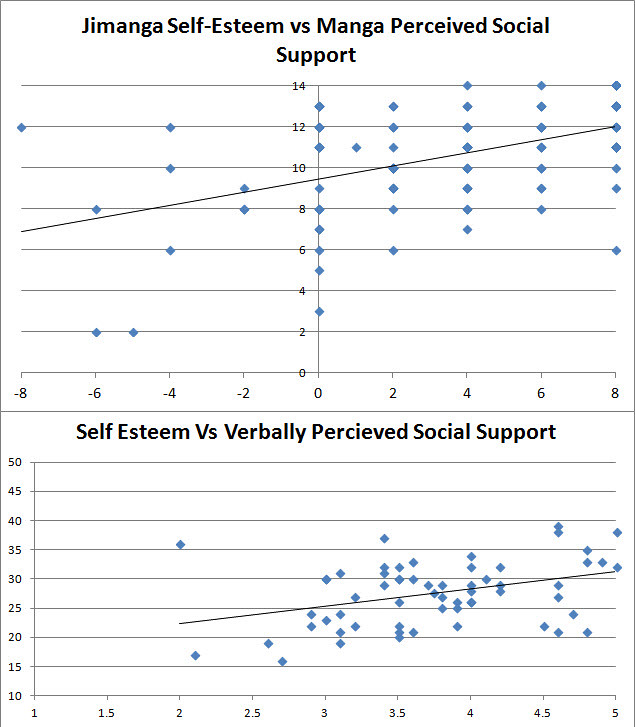
Jimanga Correlate more than verbal Measures
Labels: blogger, cultural psychology, japanese culture, nihonbunka, self, 日本文化
Thursday, January 22, 2015
Manga Social Support Scale
Japanese show only a weak correlation between self-esteem and perceived social support. In a recent survey of mine in Japan, the correlation between perceived social support and self-esteem was found to be 0.36. This is assumed to be because as "collectivists," the Japanese are thought to place a greater emphasis on humility and social censure and unpopularity may be heaped upon those who talk themselves up.
All the same, the lack of self-esteem among Japanese, with levels at about 63% of Americans, is thought to be a problem. I think that problemitization of the lack of self esteem among Japanese, as measured by the Rosenberg Self Esteem scale is "Because of the pivotal and often grossly exaggerated role attributed to verbal language"(Furth, 1973) which is as unimportant to the Japanese (Kim, 2002) as it is to the deaf (Furth, ibid).
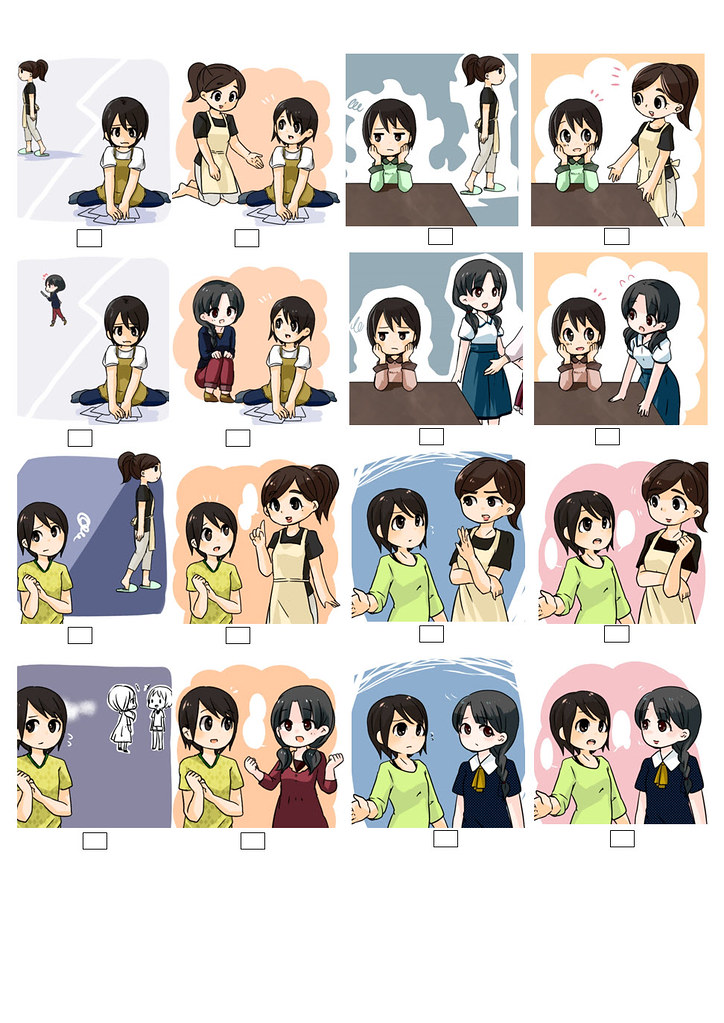
The correlation between Manga Social Support and the Jimanga Manga Self esteem Scale, was however a more robust 0.52. Not as strong as found linguistically among Americans, but at least those that represent themselves positively in manga, represent their social support positively in manga as well. I hope to be able to have the artist, Ms. M. Fujimura, make a male version of the above scale with a male protagonist and male friends, which should improve the correlation.
Thanks to Ms. Fujimura and Professor Yoshiko Tanno of Tokyo University, whose invitation to present to his seminar students, about 10 years ago, inspired this research.
Bibliography
Budd, A., Buschman, C., & Esch, L. (2009). The correlation of self-esteem and perceived social support. Undergraduate Research Journal for the Human Sciences, 8(1). Retrieved from http://ift.tt/1yOMVh6
Furth, H. G. (1973). Further thoughts on thinking and language. Psychological Bulletin, 79(3), 215–216. doi:10.1037/h0034011
Kim, H. (2002). We talk, therefore we think? A cultural analysis of the effect of talking on thinking. Journal of Personality and Social Psychology.
Leary, M. R., & Baumeister, R. F. (2000). The nature and function of self-esteem: Sociometer theory. Retrieved from http://ift.tt/1AQEj4E http://flic.kr/p/qBhJpH
Labels: cultural psychology, japanese culture, nihonbunka, 文化心理学, 日本文化
Friday, January 16, 2015
I am Charlie: Not a mere image

With the tragic slaying of French journalists, and caricature artists, most of the world mourns, myself included.
In Japan however, the reaction was tempered. The Asahi Newspaper, normally quite vociferous regarding the protection of freedom of expression, even featured the following satirical poem (which are, I would argue, the linguistic Japanese equivalent of "mere image" satirical cartoons) this morning
表現の自由に混入する憎悪
Freedom of expression
Includes added
Hatred
The hatred referred to in the satirical poem may refer also perhaps to the murders, but I am afraid it refers primarily to the "Freedom of expression" in which the Japanese satirical writer felt there was an admixture of hatred.

Joe Sacco, the artist of this second image implied in his cartoon "Joe Sacco: On Satire – a response to the Charlie Hebdo attacks" that as a result of the geopolitical situation in the Middle East, then even if there was no hatred in Charlie Hebo's expressions, Muslims have geopolitical reasons, and suffering, to be especially sensitive towards being represented in a humiliating way, as blacks and Jews do, or did especially in the past.
It is my view, however, there are additionally enduring cultural reasons why Asians are more sensitive to humiliating images, because unlike Westerners, they do not see them as "mere" images but rather even representations with which they may identify. Images bear meanings, soul, love and even hate.
This difference in the cultural perception of images may be one possible factor in the tragedy. There are laws against "hate speech" in many Western countries, but when it comes to images, they are thought/seen to be "mere" images.
Since at least the time of Plato and Aristotle, Westerners have believed that they and the world are not "mere images", nor any part of this fleeting photostream of sense impressions, but that there is another world of "forms", "concepts", or more recently "physical matter", that underpins the image. In Japan, on the other hand, Tetsuro Watsuji (1937) argued that it is the face, or mask, that provides the "centre of gravity" of the Japanese self, not a concept, nor a self-narrative.
Westerners believe the self to be a product of the self-narrative, the experience of hearing themselves speak. This is related to the nature of the "generalised other" (Mead, 1967) or "superaddressee" (Bakhtin) to whom Westerners, but not Japanese, address themselves in language-as-thought (Kim, 2002).
In other places, where there are more literal "impartial spectators," -- the Japanese have a mirror, or the Sun Goddess, in their heads -- people exist as seen (see Heine, Takemoto, Moskalenko, Lasaleta, & Henrich, 2008). People, groups, and things do not centre upon shared concepts, but are a network of binary relations (Yuki, 2003; Lacan, 2007, see e.g. Pile, 2013 p. 130), usually with a representative "character" such as Kumamon, "persona" or face such as that of his Royal Highness the Emperor and symbol of Japan.
The image above top is not the man but "merely" an image in the West. Here in Japan, however, the deceased are represented as images(iei, 遺影)in which their souls are thought to an extent to inhere.
May the man, his soul, those that loved him and the world, have peace.
Bibliography
Bakhtin, M. M. (1986). Speech Genres and Other Late Essays. (V. W. McGee, Trans., C. Emerson & M. Holquist, Eds.) (Second Printing.). University of Texas Press.
Heine, S. J., Takemoto, T., Moskalenko, S., Lasaleta, J., & Henrich, J. (2008). Mirrors in the head: Cultural variation in objective self-awareness. Personality and Social Psychology Bulletin, 34(7), 879–887. Retrieved from http://www2.psych.ubc.ca/~heine/docs/2008Mirrors.pdf
Kim, H. S. (2002). We talk, therefore we think? A cultural analysis of the effect of talking on thinking. Journal of Personality and Social Psychology, 83(4), 828.
Lacan, J. (2007). Ecrits: The First Complete Edition in English. (B. Fink, Trans.) (1st ed.). W W Norton & Co Inc.
Mead, G. H. (1967). Mind, self, and society: From the standpoint of a social behaviorist (Vol. 1). The University of Chicago Press.
Pile, S. (2013). The Body and the City: Psychoanalysis, Space and Subjectivity. Routledge. https://books.google.co.jp/books?id=X1qN4siP0AcC&lpg=PA130&ots=lrX_8UPWUn&dq=lacan%20%22binary%20relationships%22%20Imaginary&pg=PA130#v=onepage&q=lacan%20%22binary%20relationships%22%20Imaginary&f=false
Yuki, M. (2003). Intergroup comparison versus intragroup relationships: A cross-cultural examination of social identity theory in North American and East Asian cultural contexts. Social Psychology Quarterly, 166–183. Retrieved from http://www.jstor.org/stable/pdfplus/1519846.pdf
Watsuji, T 和辻哲郎. (1937). 面とぺルソナ. 岩波書店.
See Also
One Japanese article suggests that the leniency towards cartoons has something to do with the Western ego.
adishakti.org/_/goddess_remains_the_esoteric_heartbeat_of...
Labels: autoscopy, cultural psychology, culture, image, japan, japanese culture, Jaques Lacan, Nacalian, nihonbunka, 日本文化, 自己, 自己視
Jimanga Test of Self Esteem 2

Manga by Miki Fujimura. There is another set of 14 manga that are the stimuli. This is the response page. Email me for the complete set (as yet untested). Thank you Ms. Fujimura.
Labels: blogger, Flickr, japanese culture, jimanga, Nacalian, nihonbunka, ジマンガ, 日本文化, 自慢画, 自漫画
Wednesday, January 14, 2015
Kanji in the Mirror of the Heart

This ability to turn to view things from 180 degrees away from their line of sight, to see apart from sight (離見の見), enables Japanese people to have a visual self, which focussing as it does upon the surface of the body, is at the same time a reminder of the principle of interdependence. This visual self, is in my opinion the interdependent self (Markus and Kitayama, 1991).
Reminding Japanese as it does of the interdependence and externality of self - the Japanese see themselves in their games, dreams and memories - the Japanese visual self also allows the Japanese to change, chameleon-like, and have a set of selves, or characters , appropriate to the social milieu in which they are situated.
I hope that the ability to read these reflected Kanji will correlate with private shame, and interdependent self views but since both measures are linguistic, and the Japanese are not, I do not anticipate a strong correlation.
Sasaki & Watanabe 佐々木正人, & 渡辺章. (1984). 「空書」 行動の文化的起源. The Japanese Journal of Educational Psychology, 32(3), 182-190.
Labels: blogger, cultural psychology, Flickr, hazel markus, interdependent, japanese culture, mirror, Nacalian, nihonbunka, self, 日本文化
Tuesday, January 13, 2015
Tea Ceremony Forms by Pinky Joe

Labels: blogger, Flickr, japanese culture, nihonbunka, 日本文化
Monday, January 12, 2015
Mythic Islands: The significance of "Big Island"

Thursday, January 08, 2015
Writing, and Speaking, in Space in Time

This sort of test should be doable using an animation function in Powerpoint. I predict that Japanese who have high private shame will be able to recreate characters written in space and time. Somehow I feel that there would also be a greater ability among those Japanese, like my son, that practice forms or kata (in my son's case, karate kata/forms). Again, this ability, to read characters written in space in time, is greater among the deaf, who do not use phonetic mental imagery.
I may have a greater ability than many Japanese to maintain a phonetic trace in time due to all the time I spend "listening to myself." Derrida writes: To listen to oneself, can that be pleasant? Can one find that pleasant without the nasty taste of a poison, or the foretaste of an illness? I doubt that more and more.
Image from Emmorey, K., Kosslyn, S. M., & Bellugi, U. (1993). Visual imagery and visual-spatial language: Enhanced imagery abilities in deaf and hearing ASL signers. Cognition, 46(2), 139-181.
Labels: blogger, deaf, Flickr, japanese culture, nihonbunka, 日本文化
Seeing Sideways Like the Deaf

When Japanese sit in circles in groups they often have a great ability to sense the consensus of the group as judged from the expressions and non verbal communication of other group members. I find myself having to move my head to look at the all the other members in order to be able to mimic the same trick, but Japanese seem to be able to use peripheral vision and oblique facial views. I have also hypothesized that the Japanese should have cognitive skills similar to those of the deaf, since they are less likely to use (and their problem solving skills are even impaired by using) phonetic mental imagery (Kim, 2002).
Deaf children are better at the Benton test as shown in the above graph. Japanese subjects should outperform Western subjects too but direct comparisons would be difficult due to the need to use a different set of faces. I note that an Asian versio of the test exists.
Image from Emmorey, K., Kosslyn, S. M., & Bellugi, U. (1993). Visual imagery and visual-spatial language: Enhanced imagery abilities in deaf and hearing ASL signers. Cognition, 46(2), 139-181.
Labels: autoscopy, blogger, Flickr, japanese culture, nihonbunka, visualization, 日本文化, 自己視
Japanese can See Inside Things

Labels: blogger, Flickr, japanese culture, nihonbunka, psychology, 日本文化
Monday, January 05, 2015
The Game of Life

Western games on the other hand, such as Call of Duty, aim for highly realistic visual depictions to the point where it almost feels like the game is visually real but simplified idealised stories where basically almost all of them consist in a battle-field where one shoots and kills a lot of enemies, and or drives fast, and that is it. That is to say the Japanese want realism in the linguistic (story) aspect of the game, but idealisation in the visuals, whereas Americans want realism in the visuals, but simplified idealisation in the story. In line with this, the area in which one can choose is also limited by their respective realism. While Japanese games (like the sugoroku above) have realistic stories one often is constrained by them.
In the game above there are different game paths but no choice as to which path one can take, which (like in "The Game of Life") is decided by the roll of a dice. One is however offered a wide in the visual aspect of the variety of characters that one can become. In Call of Duty, I predict that there is a wide variation in the routes one can take through the battlefield but I hypothesise that the number of people - in terms of their visual aspect - one can control is very limited.
Japanese games usually also provide an objective visual perspective on the player, seen from the outside. The Japanese player becomes the "impartial spectator" or "generalised other" of the stylised visual avatar that he controls. Japanese games mirror Japanese life. Similarly the Western player becomes the linguistic impartial spectatory or generalised other of the character that he controls, as we do in life, but I am not sure in what game phenomenon that this consists. I guess it is related to the way in which Western games are often equipped with headsets using which one can talk to other players. Verbally the Western player is - like the Japanese viewpoint on Mario- out of the action, ablel to say "Oh no I have just died," but experience his own visual death with the screen going red and or blank. Japanese can watch mario drop out of the screen, while their viewpoint remains visually immortal.
In addition to tourism, reviewed in the next post, this relates (Mr. Imamura) to the hopes and dreams that Japanese and Westerners have of the afterlife. Westerners (asterror management theory proves) aim for symbolic importality, to keep on talking or being talked about after they die. They want to become the fiction that they have lived. Japanese however, hope to live on in the visuals that they have created - primarily their offsprung- their grave, the picture hanging above the household buddhist altar and imagining themselves visiting and watch and protecting their family once or twice a year, at least at the festival of obon. The Japanese too want to become the fantasy that they have lived upon their death. Fame in the sense of name is far less important.
Come to think of it Ms. Fujimura has pointed to a great way of understanding Japanese and Western culture since each express themslves, their selves, their ideals, so vividly in their games. Thank you Miki Fujimoto.
Labels: blogger, choice, cultural psychology, Flickr, game, Nacalian, nihonbunka, reversal, theory, 日本文化
Friday, January 02, 2015
Caught in Kawaii: The proprioception of the pretty

Labels: blogger, cute, Flickr, japanese culture, kawaii, mirror, nihonbunka, 日本文化
Saturday, December 27, 2014
Visualness Vs. Continuity
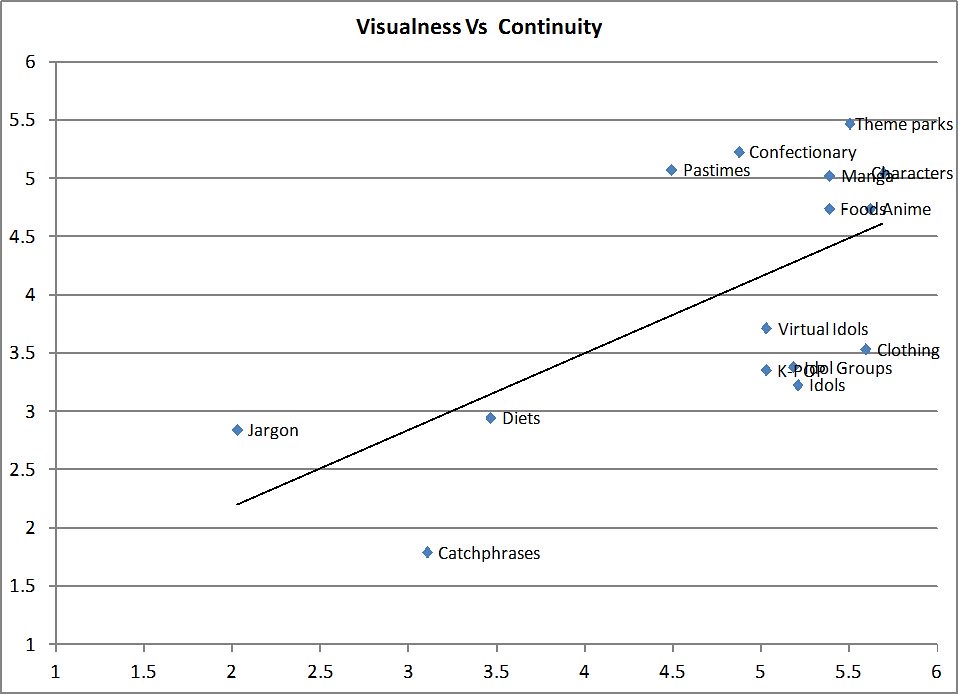
In Japan continuity, identity and soul resides in the visual and my seminar student, Masaki Abe (2014) appears to have proved it. In an initial experiment we asked for social phenomenon that have longevity and continuity and those that do not, those that are faddish. In a second experiment, subject were required to rate these phenomenon according to the extent to which they were visual and had continuity. It was found as predicted that there is a strong positive correlation (r=0.64) between visuality and continuity in Japan.
Jargon included also "modes of speech" such as speaking like a posh person, and was considered, along with diets, and the catch phrases of comedians to be the most faddish phenomenon there are. Maruyama Masao claimed that this faddishness extended to theories too. Perhaps my theory will have its day.
Hello Kitty, a recognisable face and little more, is 40 years old this year.
Abe, M. 安部将輝. (2015). 音と流行の心理学 (未発表卒論). 山口大学経済学部観光政策学科, 山口市.
Labels: blogger, Flickr, japanese culture, nihonbunka, self, 日本文化, 自己, 自己視
This blog represents the opinions of the author, Timothy Takemoto, and not the opinions of his employer.