
Wednesday, August 23, 2006
Ghost_with_open_arms

Maruyama Oukyo was a Japanese painter known for realism and occasionally painting ghosts. The painter is rumoured to be the originator of representations of ghosts with no legs but I suspect that the tradition is far older. Ths shows the artist being shocked as a female ghost appears out of one of his own paintings, with the image coming to life.
I have two theories about Japanese culture
1) The internalised other of the Japanese self looks rather than listens - it is the imaginary other, an eye in the sky rather than the symbolic ear of the Other. Hence, the Japanese self is in the visual, rather than linguistic plane.
2) The tabu (and perhaps the tabooed other) of Japanese culture is upon the feminine rather than the masculine. Hence Japanese horror focuses upon horrible women, while Western horror largely focuses upon horrible men.
This photo, "The Ghost with Open Arms" links the two theories together.
It shows a horrible woman coming out of the imaginary plane, female horror coming out the image. This theme is surprisingly popular in Japanese horror.
Ringu, probably the most famous Japanese horror film of recent years features Sadako, a ghost or monster that emerges from the screen of a television set when playing a particular, haunted video tape.
Izakayayurei ("Ghost Pub", 1994) is the story of a publican who promises his dying wife never to remarry, and then when he does his first wife returns as a ghost. In an attempt to have the first wife's ghost return to the other world, they are entrusted with a traditional Japanese scroll drawing of a ghost (as is being drawn in the picture above can be viewed here) which is said to be a portal to the other world.
I think that there are a lot of ways that this might be explained. Freud, Mead and others claim that we must internalise the view of another in order to have self at all. The other of the self has to be hidden, for the self to be the object of identification. It is enevitable therefore that something needs to be hidded in the plane, domain, or medium of self-identification, but what? A hidden eye or ear? I don't think that there is any need for an image of the other but I am not sure.
I think that the tabu bears upon the medium, image or language, itself.
In order for there to be a human self, we identify with a self-represenation. But if we were aware that the self is only a representation, then we would not be able to identify. Hence, we must forget that it is only a representation. We achieve this by a tabuu on the medium of self represenation, pretendind that our favoured medium is essence in itself.
Hence Westerners are inclined to claim that self is the dialogue that the self holds with itself, that ideas (not words) exist in minds, that words cut nature at the joints, and that grammar can not be doubted (e.g. "I think therefore I am" is indubitable).
I wonder if Japanese people are similarly unaware of "the veil of perception." To what extent is everything that we see merely ourselves? This is a knotty question, and I don't think that there is a right answer. But those that see essence as idea, are inclined to believe that the world of vision ("res extensio") is a internal sensation and not "the thing in itself." Similarly in Japan perhaps, the word is seen as that chit-chat, and perhaps (a hypothesis) the image is seen to be out there and shared.
Thus the return of the medium, the return of the image in Japan, and the return of the phoneme in Western culture, might be felt ot be horrible. The Japanese are not afraid of images as entities, but of the return of the image as veneer or the horrible "tain of the mirror".
Does this form of horror also exist in Western culture, in the linguistic field?
Recently I watched the American horror film, Emily Rose about a woman possesed by demons. It bears a strong resemblance to "The Excorcist." However I did notice that a central feature of the excorcism ritual was the attempt to find out the names of the entities that were possesing the woman. They were all men of course. But what was the significance of finding out their names? Till then they had been voices. Perhaps by finding out their names, perhaps, the horrible voice (phoneme) can be returned to the realm of language. This naming of the beast, theme can also be seen in the animation of the Wizard of Earth Sea.
Perhaps there are also a prevalence of proffecies (language) coming true, horribly, in Western horror?
The Shining is a good example of the horror of words in the Western tradition. I was truly horrified to find that Jack's book was simply made up of "All work and no play makes Jack a dull boy" written over and over again. I think that the repitition of the single phrase made the medium (the ink, the paper) return, allowing us to see it for what it is: a medium and not idea. And similarly at the climax, just before Jack says "Wendy, I'm home," his sun writes r3drum on the wall in blood, which is murder written backwards. This "redrum" may in a sense be the equivalent of Sadako in the ring, at first only "noise" a pattern of sound and images, becomes real...enter Jack with his axe.
The word God (some prefer to write G_d) is often tabuu, and that the ancient Jews wrote it without any vowels YWH (Yaweh) so as to make it more difficult to pronounce. Some people write G_d, to thise day. Do not use the lords name in vain, for fear that you may realise that he is but a name? And then of course there is John, dear John.
In the beginning was the word, and the word was with God, and the word was God....And the word became flesh and dwelt amongst us, says John. But this was far from horrible. Perhaps the realisation that Jesus is the word e.g. Jesus as myth hypothesis, is this sort of horror.
Labels: culture, female, horror, image, japan, japanese culture, lacan, logos, male, nihonbunka, ring, ringu, shining, tabuu, theory, 日本文化


Thursday, August 10, 2006
Crates of Shouchuu Bottles

I think that if someone left a large quantity of bottles on a street in London then some young men, returning from the pub would find it amusing to knock over the tower of crates and smash some of the bottles.
Shouchuu is Japanese vodka. Containing only about 25% alcohol it is considerably weaker than Russian vodka. It is a distilled white spirit made from wheat, rice or sweet potatoes.
In the past Shouchuu was a working mans intoxicant. It was consumed with hot water for, the maximum bang per buck. More recently however the existance of a great number of provincial shouchuu distilleries with a low volume of production, has created a new market, rather that which exists for "fine wines" made up of customers who covet the distinctive flavour and aroma of the various provincial brands.
Would you be able to leave crates of bottles on a street in London?
Labels: crime, japan, japanese culture, nihonbunka, 日本文化
Sunday, August 06, 2006
Unlocked Mountain Bike
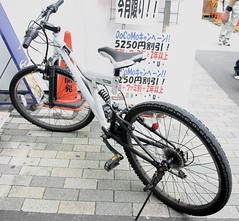
More than 30% of Japanese victims where victims of bicycle theft. This is hardly surprising because a lot of people do not even lock their bicycles up!
This is a bicycle in Northern Ireland. Note the U Lock fixing the bicycle to a bench.
www.flickr.com/photos/rosinante/44258869/
While Japan has incredibly low rates of concrete, visible crime, it comes 18th out of the 22 OECD countries in terms of corruption. I am looking for figures on copyright infringement.
I argue that this disparity is evidents of the fact that Japanese people are very much aware of the gaze of others, to the extent that they have externalised a generalised gaze. This means that they feel bad about performing visible and imaginable antisocial acts such as all the crimes listed in the first OECD victimisation ranking. Westerners on the other hand have internalised the ear of the other such that we find it painful to perform acts which are difficult to narrate in a non antisocial way. Hence crimes of corruption which often involve reprimandable linguistic acts, are more painful, more likely to arouse feelings of guilt among those from the cultures of the religion of the book - the West (and the Middle East, I am not sure why they are fighting each other).
Labels: crime, culture, image, japan, japanese culture, logos, nihonbunka, occularcentrism, reversal, theory, 日本文化
Wanting to be White

Labels: culture, japan, japanese culture, nihonbunka, westernisation, 日本文化
Are You Riding a Stolen Bicycle?
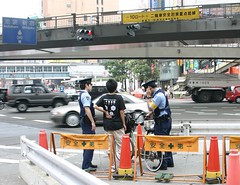
From a very brief survey of the people that the police were stopping and checking, it would seem that they were concentratiing on those riding the standard, cross bar-less, shopping bicycles (mama-chari - mum's bikes). This suggests to me that the majority of bicycle theft is of such bicycles for the purpose of riding them rather than for the purpose of selling them to a third party. There are quite a lot of expensive mountain bikes and road bikes parked with flimsy locks, or no locks at all. But there are even more shoppers, without locks or with easily breakable built in front wheel locks (which can be twisted so that they do not interfere with the movement of the spokes. These bicycles are about 100 USD new in Japan. They are often abandoned even by their owners and large numbers of them are seen at rubbish collection stations on those days when "large rubbish" can be thrown away. It is my perception that some Japanese people tend to see such bicycles almost as a communal resource. Some towns, such as my old town of Kurume, have organisations that provide bicycles - painted blue - at stations for free for public use.
Perhaps the OECD statistics regarding the rate of theft of bicycles and the fact that bicycle theft represents 30% of crime as experienced by Japanese.
Labels: crime, culture, economics, japan, japanese culture, nihonbunka, 日本文化
Saturday, August 05, 2006
Mirror in Shrine
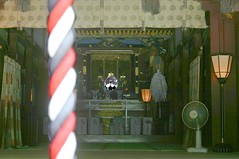 Sometimes when praying at a Japanese shinto shrine, one can see oneself reflected in the mirror at the back of the shrine. At other times one can see the reflections of those standing nearby, as in this photograph. I don't think that it is important that any one be reflected in the mirror. Indeed it is possible that it is better that the mirror is empty. There is a ooth in Japanese to the effect that God (kami) is a "mirror" (kagami) without "me" ( or self or ego = "ga"). I claim tha the mirror in the Shrine is of central importance for understanding Japanese culture and that the Japanese have internalised the view point of society as a mirror.
 technorati tags:mirror
Labels: japan, japanese culture, nihonbunka, specular, theory, 日本文化
Monday, May 22, 2006
Oshare Majou (The Best Dressed Witch)
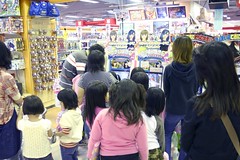
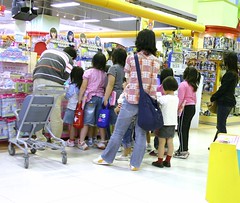
The Sega video game, "Oshare Majou Mahou Card" (Magic Card of the Best Dressed Witch), allows Japanese girls to turn themselves into well dressed dancing caucasians in the virtual.
Oshare means "dressed up" or "well dressed" but as well see, this is a competitive game so I have rendered it as "Best Dressed"
The official site is in Japanese.
The game seems to be a combination of a virtual version of the video dance game "Dance Dance Revolution," and virtual fashion using swipe cards, in a competitive format. Players purchase clothes which their virtual personas wear before taking on the computer or a friend in a battle of who is the most "oshare," where oshare means well dressed and cooly attractive at dancing. By pressing the keys in time with the music, the young lady with the best fashion sense (I am not sure of the criteria) and best moves, wins the battle of the Best Dressed Witch. Perhaps this information is stored on the swipe card. I am not sure.
The two girls are called "Rabu and Beri-" ("Love and Berry") often being appended to "RabuBeri" or "Raberi" ("lovely"). In their cartoon form these characters are pretty Mid Pacific as are many manga characters, with features that do not define them as being part of any race or nation.
Recently two caucasian models have been used to represent Love and Berry in some magazine adverts directed at young girls.
The game is enjoying immense popularity with cues of preteen girls and their parents forming at video arcades all over Japan.
Labels: japan, japanese culture, nihonbunka, westernisation, 日本文化
Sunday, May 14, 2006
Yaoi - No Mountains, No Valleys, No Meaning, Just Gay Sex
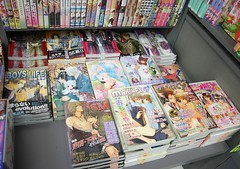
Yaoi comics are purchased by young women who find reading books about male-male romantic/sexual relationships, to be less embarassing and more interesting than reading about relationships between men and women. Most commentators suggest that this is because women are repressed and want to identify with males who have a slightly better, freeer, more expressive position in Japanese society. I think that this interpretation only slightly misses the mark.
As I have mentioned elsewhere, it seem that in Japan, expressions of *male* sexuality are not taboo, whereas any expression of female desire has been hidden since the beginning of time. Hence, when young girls want to read about romantic love and sexuality, they find man on man love and lust, pure and innocent and unthreatening.
There is method to this madness. I call it Japan as Lacan in the mirror.
Labels: culture, japan, japanese culture, Jaques Lacan, lacan, manga, nihonbunka, sex, taboo, tabuu, theory, 日本文化
Buddhist Scriptures Unread

This is the first time that the base of the temple has been open to the viewing public. Normally the only person to enter the temple is the priest who goes to extract one part of one volume of the scripture. For the rest of the time, all the information, all the philosophy held in this tower is treated as a holy relic. No one reads it. No one looks at it. It is just there.
Not only is Japanese Buddhist scripture "unread" I would go far as to say say that *anti-logocentrism* is a prominent feature of *Japanese* Buddhism or perhaps the Shinto-Buddhist syncretism that exists in Japan.
Zen Buddhism is quite clear about this. Zen buddhism claims (in lanaguage) to be the Buddhism outside of scripture (language). Zen Buddhists are not afraid of the liars' paradox, but slap it in the face.
And most Japanese lay Buddhists use the scripture not as something that explains why the world is as it is -- a mental structure confabulated by the minds of humans -- because to become so involved with the scripture would be to make another structure, another confabulation. Instead they *chant* thewordsthatclaimitisallaconfabulationandbydoingso...reach the empty, wordless, truth.
My bashing people over the head with Buddhist books photo set is "arguing" (by bashing) the or their authors are Cretians, right and wrong at the same time. Thus, rather than get all fussed about paradoxes, Japanese Buddhist priests just bash people over the head with the books, and be done with it.
But this is not news to Gnostics. In the beginning was the word. Before that there was the demi-urge. Or was it the Buddha?
Labels: japan, japanese culture, nihonbunka, 日本文化
Hard Gay Toy
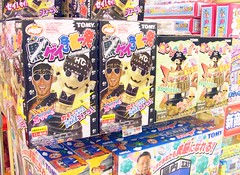
He appears to be popular among young children. This produced by TOMY is for preschool children.
The entertainer is, in real life, heterosexual. I think that it is important however that he is mimicing the sexual activities of male homosexual, since in Japan it seems, that while male sexuality are not taboo the sexuality of women is. Thus, in this and other situations, due to the absense of any female participation, portrayal of purely male sexuality, in the form of male homosexuality, is deemed fit for consumption even by children.
Since in the West, the severity of taboos upon male and female sexuality may be reversed, it is concievable that there is nothing more likely to cause offence than the portrayal of male homosexuality.
I do not think that the tolerance towards such portrayals has a lot to do with the tolerance towards real homosexuality in Japan today, at least according to small sample of gays that I have met. Today, I am told, it is not easy to be gay or come out in Japan.
****************************************************************************************
I meant to write about cultural differences, not about the reasons for negative reactions towards homosexuality in the West but I have. And since I have, I feel that I should say a bit more about what I am asserting; homosexuality in the West is doubly damned for being both homo and sexual:
1) "homo" as opposed to hetro and thus different, and just because it is different the object of prejudice
2) "sexual", in the sense of being related to sex act and thus associated with that which is often the object of taboo in the Western tradition.
But, I am sure that there are factors too, and all of them are unfortunate.
Labels: japan, japanese culture, nihonbunka, sex, 日本文化
Kitty Car
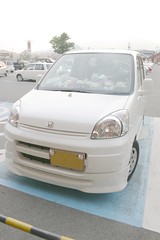
In Japan there is a tremendous tabu upon the sexuality of women. This can be seen in the fact that while men pee on the streets women use "sound princess" devices to hide even the sound of their pee. Or again in the fact that women who express their desire are seen as being monsters, such as Hanya.
As argued by Foucalt and others, any desire that is repressed returns in other forms. The more a desire is repressed, the more it comes back in a modified cleansed, neutered way.
While Japanese women are not allowed to give expression to their desire directly, Japanese society is awash with expressions of de-wombed maternal love. Being cute (kawaii) is very positive and important. Perceiving things as cute (kwaiiiiiii) is likewise postive and important. And surrounding oneself with cute things, such as many "hello kitty" cat dolls is likewise a ritual expression of womb based sexuality without the womb. In this car there are babies everywhere but they are all made of polyester and nylon. There were even baby sized dolls on the back seat.
The hello kitty characters on the back seat are the size of young children. The numberplate is held on by Hello Kitty headed screws and the water jets for the windscreen are squirted from a Hello Kitty capped nozzle.
Hello Kitty is copyright the Sanrio corporation.
Labels: japan, japanese culture, nihonbunka, 日本文化
De Rigueur Cute

Between its legs, by chance, is a pine cone containing stuffed, coloured cloth balls. The phone is connects to a local taxi company.
"Hello Kitty" the name and design is copyright/tm Sanrio corporation.
Labels: japan, japanese culture, nihonbunka, 日本文化
Culture or Cruelty
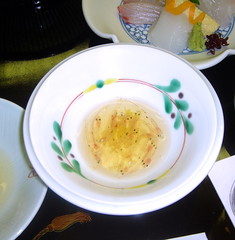
The practice of eating small "shirao" fish live is a traditional way to celebrate the arrival of spring in Japan.
Is it cruel? Is it any more or less cruel than a beefburger?
I think that there are a lot of issues here.
1) The intelligence and ability to appreciate pain or suffering of the species that one is eating. I am not sure, but I think that there is a continuum between plants and animals. Are vegetables, viri, (yoghurt) baterial, algae, plankton, shripm, fish, sheep, cows, horses, pigs, dogs, whales, apes, okay to eat? I have probably got the order wrong and I think that some of these are of a similar level of intelligence, ability to appreciate pain or suffering. Here we are talking about a small fish. I am not sure of their level of awareness.
2) The suffering of the food. This is factored by the speed with which one kills the food, and the stress that the food suffers prior to its demise. There are laws about this in various countries that obviously relate to the criteria (1) above. Here we are talking about a fairly painful, slow, stressful method of killing.
3) Secondary impact of eating the food. Shiroibasket shoes mentions that he does not drink milk. Milk in itself probably does not suffer but the secondary impact of drinking milk is that cows or their offspring are slaughtered.
4) The reasons for eating the food. This is complex. I would like to point out two factors.
4.1) The nutritional importance to the eater. If the eater is going to starve then we are more likely, I think, to allow eating further up the food chain, even to the point where one might accept canibalism when there are three men in a boat and no food? Perhaps.
4.2) The symbolic factor. By this I mean to extent to which the food is eaten for...hmm...the significance that the food and its preparation has. There are all sorts of things going on here and I am not sure whether they are mitigating or incriminating. For example,
4.2.1) Eating steak because it is deemed manly, preditorial, strong to do so.
4.2.2) Eating dog because (perhaps) in part it is defying a tabuu, daredevil, radical, virile.
4.2.3) Eating cow that has been bleed to death due to beliefs about the purity of the food.
4.2.4) Eating these small fish for the awareness of the season and that one is an ominvore, or to return to ones nature.
4.2.4) Eating fish eggs (caviar) because they are expensive and by so doing we express our wealth.
4.2.5) Eating an animal as part of a ritual.
4.2.6) Eating a piece of bread that is believed to be a part of a human being, as in the Catholic Mass.
I do not know about how significance effects our appraisals of consumption but it is bound to depend upon whether that significance is shared. Significance is notoriously culturally determined, but perhaps there are ways appreciating the significance factor of others, by analogy from an awareness of the significance of ones own. In other words, someone that eats steak might think that eating fish live is brutal, until they become aware of the fact that their own steak eating is, like the fish eating, a symbolic act.
5) Cruelty for the sake of awareness of cruelty. (for a lack of a better way of putting it)
This is really a part of (4 - the significance) above but it interests me and I think that it bears upon the eating of these fish. First of all, I do not mean to assert the existance of universal "cruelty." Perceptions of cruetly are varied. However, I merely that there is a question in everyone's mind, "Is it okay to eat this?" Now, let us say that there are times when the answer is a mitigated "no." But one might still go ahead and do it in order to be aware of wider situation.
I think that perhaps, eating these fish live draws ones awareness to the fact that the bacon, steak, fish that one is eating are living. It draws ones attention to the horror of what one is doing. And by drawing attention to that horror, it causes the eater to be more wary and appreciative of the "cruelty" of their behaviour.
One might for example demand that all those that eat steak kill a cow with a sword every x years. Killing a cow with a sword, by ones own hand would be painful for the cow and the eater. But, it may result in a more balanced view of eating cow.
Personallly, I would like to insist that all those that eat steak and fish and any living thing, do it in the flesh every now and again.
In the extreme, it might be profitable to have people bite the cows neck, or if not bite it, then slit the throat of the cow with their own hand, or if not do that then at least whatch the cow being slaughtered. The act would brings home the reality of that which is otherwise taken for granted. Even it is an act that we might not approve of - slitting a cows throat is probably more painful for the cow than the present method of killing - but I think that if beefburger eaters were required to do this "cruetly" then they might more wary and aware of the consequences of ordering a Big Mac. And in that situation, perhaps, humans would eat animals at a more "acceptable" (this is my personal preference) rate.
So, I think that by drinking live fish the Japanese maintain an awareness of results their culinary preferences. When the Japanese stop eating live fish they may eat beefburgers as much as Britons and Americans. When this comes to pass, and we are on the way there, I think that it will be sad. So here is to cruelty for the sake of an awareness of cruelty.
Perhaps.
Labels: japan, japanese culture, nihonbunka, 日本文化
Bonjour they say

With images like this, it is not surprising that Japanese want to undergo cosmetic surgery to make their noses more pointy. At the same time, there may be more to this practice than meets the eye. I think that if the mannequins were Japanese then they would look too lifelike, too scary, since the Japanese identify more with the body.
Labels: japan, japanese culture, nihonbunka, 日本文化
Japanese Fashion Feminisation
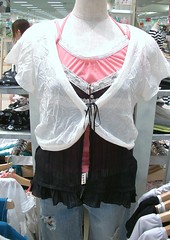
In the West there seems to be a gradual masculinisation of fashion. Both boys and girls wear jeans (formerly male labourer's garb) and T-shirts (formerly boys sports wear). In Japan however, fashion is feminised. The guys have taken to wearing make up, and the girls tend towards the ultra-cute.
Labels: japan, japanese culture, nihonbunka, 日本文化
Wednesday, March 22, 2006
Vandalism in Tokyo
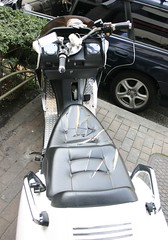
Yohei Morita suggests that the reason why this motorcycle seat was slashed may be related to the fact that the motorcycle is rather flamboyant. This possibility is born out by the experience of my friend whose Shinagawa registered Toyota Supra was scratched, apparently simply because it was flamboyant and out of place among the other cars in the car park in Kyushu. The Japanese maxim "the nail that sticks out gets beaten down," may translate to "the flamboyant vehicle gets vandalised."
Labels: japan, japanese culture, nihonbunka, 日本文化
Tokyo House Prices
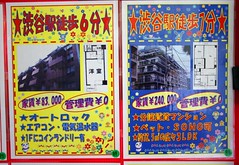
A one bedroom flat for 83,000 yen a month, a three bedroom flat for 240,000 yen a month. Not cheap. And yet more and more Japanese are predicted to converge on the cities while the population density (and houseprices) in the countryside falls. In some parts of Japan houses are so cheap that they are given away.
Most Japanese think that the Japanese like nature. Even if this is the case, it is also true that the Japanese like to live in cities not in nature even more.
When I ask Japanese people, "Why do you Japanese prefer to live in rabbit hutches next to urban stations, rather that in the splendor of the Japanese countryside?" they tell me that the environs of urban stations are more convenient, especially for work. Yes, this is surely the case.
But why to Europeans value work less than the Japanese? Why do they prefer to live in nature more? If you had the the option of big bucks in a metropolitan rabbit hutch, or a pittance in a rural nowhere, which would you choose?
Labels: japan, japanese culture, nihonbunka, 日本文化
How many months pregnant?
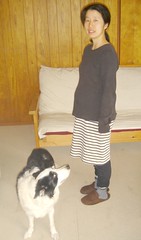
Westerners on the other hand measure pregnancy in calendar months from the date of conception, which is 38 weeks, or approximately 9 calendar months.
Aparently in Western prenatal clinics too, gestation is measured from the first day of the last menstrual cycle, which is also the first day of menstruation.
What I am not clear about is what marks the beginning of gestation, or the menstrual cycle. Cycles do not have beginnings and ends, since they are circlular.
I guess that one reason is clarity - there is menstrual blood on this day and so the event can be timed and days can be counted. But that seems like an arbitary length of time for both Japanese and Western medics to deem the beginning of gestation.
Is there a medical basis, perhaps in the fact that this is the day that the mother's temperature drops, and stays low until ovulation and Western web sites say that pregnancy is medically, 40 weeks long too?
Yasuko suggested that the current system, is based upon the transmogrification of the soul: when one egg is thrown out, the soul moves to next egg, so the life of the next egg starts at the death of the previous one.
I am not sure why gestation should be deemed to start at the death of the previous egg. Or why the menstrual cycle should be said to "start" at menstruation instead of at the end of the "previous" mensturation, or at ovulation - the day that the egg leaves the ovum.
One might argue that gestation is the time that the egg is in preparation but, in a sense the egg has been in preparation since the mother was born, or even before that. One could arge that pregnancy is almost infinite!
Upon investigation, measuring gestation from the time of the "last normal period" does seem to be arbitary - based upon a time that can be measured (when conception / ovulation are often more difficult to ascertain).
I guess that is more natural to say that pregnancy is precisely 10 womens-months since when we are talking about the cycles, periods, time span of a woman's body. If one uses calendar months then there is going to be error in estimating the babies developement depending on the length of the month.
I am told that when Western prenatal clinics characterise the development of the foetus, they also use 4 week months (to avoid error caused by the lengths of gregorian months) but in order to make pregnancy fit the calendar the first and last months are considered to be 6 weeks long.
In any event, it seems that the length of pregnancy in Japan is measured in a more natural, female oriented way, from the time of mother's last mensturation in menstrual cycles. Since it is women that do pregnancy, and it is their bodies, this seems like a very sensible way of measuring things.
In the West pregnancy is measured in a more male-oriented fashion, as the number of Gergorian calendar months from the time of conception - when the guy gets involved.
The fact that some Japanese misconcieve the length of pregnancy to be ten calendar months is discussed here. As I mention on that forum, I think that Westerner's characterisation of pregnancy as being nine calendar months involves a misconception too. No pun intended.
Labels: japan, japanese culture, nihonbunka, sex, 日本文化
Thursday, November 17, 2005
Chart of Idol Calendars for 2006

Often, but not always, they sing. The songs are usually written for them. The songs and the music are often not all that important. They do not necessarily need to have a good voice. Sometimes they may act. At other times they are simply models.
Idols are similar to Western pin-up girls. But they do not necessary show their naked bodies. In fact showing oneself naked usually, but not always, indicates that the idol is not going to be popular for much longer (a notable exception is Rie Miyazawa, who stripped and then went from strenght to strength). They are the dream girls and guys, that the purchasers of their photographs would like to meet.
Idols appear on caledars, and books of photoraphs. They often appear on television programs, usually in a guest role, as well.
In the UK, television guests --on quiz programs and talk shows-- are often simply members of the public. But in Japan it is rare to see members of the public take part. This is perhaps partly because members of the public are too shy and too modest to make interesting viewing.
Idols also demonstrate the Japanese emphasis upon the visual. It is not important that these people are talented at singing or acting so long as they are a feast for the eyes. As well as being simply beautiful in their physical appearance, they are good at striking poses and presenting themselves well. Indeed, sometimes they are not even particularly attractive in terms of their bodily shape but appear attractive by virtue of their poses, expressions, mannerisms, and behaviour. One of the most popular Idols this year is Yuka, shown smiling with a dog. She is not necessarily the most beautiful of idols but achieves enourmous popularity by her character or her ability to present herself in an attractive way. A few years ago the most popular woman in Japan was Hisamoto, a comedienne who acheived almost idol status, not simply because she is funny, and not because she has a beautiful face, but through her dedication to being 'genki,' energetic, childlike, natural, and lovable.
These images are copyright the people that appear in them and the photographers that took them. I am hoping that they are small enough to constitute thumbnails.
Labels: japan, japanese culture, nihonbunka, sex, 日本文化
Sunday, October 30, 2005
In Japan even Workmen are Cute
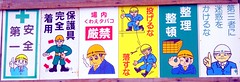
In Japanese society, on the other hand, where the womb and all it stands for is the most secret, hidden, scarlet taboo, motherly love seeps out everywhere. Even yakuza pretend to be elder brothers (perhaps in a sense mothers or care givers), and even the most hardened of businessmen learn to fawn ("amae") to their bosses. Japan is awash with fawning, spoiling, and people being cute.
Even building site labourers are cute. These work safety promotion posters depict building site labourers in a big-eyed, cute way. And building site labourers, in their knickerbockers, really do look cute too.
See also
Labels: culture, horror, japan, japanese culture, nihonbunka, taboo, tabuu, theory, 日本文化
This blog represents the opinions of the author, Timothy Takemoto, and not the opinions of his employer.