
Friday, July 29, 2016
The Sound Princess: Japanese Veil
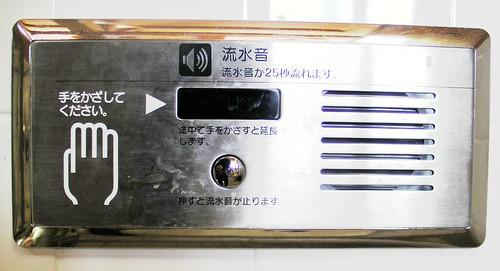
The sound princes or oto-hime is a device for hiding the sound of ones excretions, which emits the sound of running water. It is made by the Japanese manufacturer Toto. Usually only available in women's toilets (hence my inability to take this photo so far) this one was in the disabled persons toilet. The sound continues, it says, for 25 seconds during which time the user would hope to finish their 'ablutions,' which, disguised by the sounds of running water emitted from this device might not have existed at all.
Since the beginning of time, according to Japanese mythology, the Japanese have endeavoured to hide the desire, sexuality, and nature of women so as to raise the feminine (or castrated feminine) to the level of 'social principle' (Kawai, 1982) or role model.
An as a result all the Japanese to a man, aspire to be a nice kind harmonious watashi a first person pronoun used by men and women, originally only indicating, the woman.
To this day the desire, sexuality, and nature of women is so taboo, so off limits, in Japan that Japanese women: read pornography only about men having sex with men; do not use tampons, use toilets hidden further than those of the gents, laugh behind their hands, wrap themselves in layers layers and of underwear, never suffer from flatulence, almost only use the back-channel in mixed-sex conversation, only moan "no," and use electronic sound-emission devices, such as that shown above to disguise and hide the terrible tinkle or splash.
And I mean terrible. When Japanese women show their true nature, they can often wither Japanese men with a glance.
The noise of the sound princess, and many of the other important meaningless noises emitted by Japanese culture (politician's crooning, sports-persons' shouts, Buddhist chants, pachinko cacophony, mid-day and evening come home Tannoy's, supermarket endless tapes, and New Year's temple bells) may have structural similarities with the Biblical fig leaf and the veil. The sound of the sound princess is a audio cover of female desire, as opposed to a visual cover of male desire.
Click here for YouTube Videos with the sound of the sound princess.
Kawai, H. 河合隼雄. (1982). 中空構造日本の深層. 中央公論社.
Labels: horror, japanese culture, matriarchy, nihonbunka, reversal, ring, ringu, tabuu, ホラー, 日本文化


Thursday, July 28, 2016
Coffee Vending Machine Food Preparatation Views
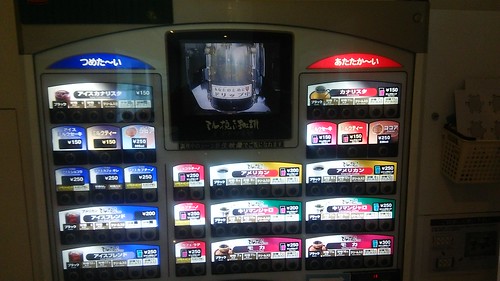
Just as Japanese ramen restaurants, sushi restaurants, and in the extreme fireside grill (robatayaki) restaurants provide their clean freak, and I argue, scopophilic Japanese clientèle with the opportunity to see their food being prepared, so it is with some Japanese coffee vending machines. The coffee vending machine shown above, equipped with several internal cameras, provides purchasers with a video of their coffee being made (centre top). I should have taken a video of the inspiring internal video.
There is always the possibility that the machine is in fact making coffee using instant coffee powder, and showing everyone the same entertainment video but, even if this were not in Japan, the raw, slightly out of focus, steamy nature of the video made me trust the internal view it provided completely and the coffee taste just a little bit fresher.
Visual information augments, and even overwhelms, that obtained by the nose and the mouth. I hypothesise that even if the machine were indeed really using Nescafe and just showing a fake video, I would be fooled into thinking that the beans were ground and the coffee dripped.
Labels: japanese culture, nihonbunka, 日本文化
Shinkansen Bullet Train Urinals

Bullet Train Urinals do not have locks. In place of locks bullet train urinals have windows which allow those outside to see if there is someone using the urinal or not. As a senior British male I find it a little uncomfortable to be seen while urinating, and still more for my being seen to be the only thing that prevents people from opening the door while I am urinating - not that anyone would barge in.
Ideally I would like to be able to emerge from a toilette (Americans are so uptight they have to call them "restrooms") secure in the knowledge that those outside in the corridor do not know what I have been doing in the toilet (washing my hands, or even "resting"). In the case of a urinal cubicle, this practically impossible, but the addition of the window and the lack of the lock makes me feel like I have just urinated en plein air. Urinating outside is something that Japanese men did not feel uncomfortable doing as recently as 20 years ago even in groups.
These days it is only young Japanese boys that urinate outside in groups. Using a Bullet Train urinal makes me feel an age younger than with which I feel comfortable. I respect Japanese men for the their lack of prudery. I note however, that Japanese women are so sensitive that not only would it be utterly unaccepted for them to be seen whilst urinating (kami forbid) but Japanese women use electronic devices (otohime) so that they can not even heard urinating. Japanese women can emerge from toilette cubicles in that ideal situation: no one can be sure of what they have been doing.
Labels: horror, japanese culture, nihonbunka, 日本文化
Saturday, July 23, 2016
Magearna is Reason and Eve

The latest movie (Pokémon the Movie XY&Z: Volcanion and the Mechanical Magearna) from the Pokémon franchise, written by Atsuhiro Tomioka the same writer as the last, replaces Hooper and mini Hooper with Volcanion and Magearna. Volcanion, like Hooper, has a hoop, and is a bit too strong for his and his surroundings' good.
the Exquisite Magearna is the first robotic Pokémon built by the those blue eyed, blonde, science fanatics -- Westerners -- that often feature in Japanese animations. Magearna has a metal body, crucifixes for pupils, and a sciency cog-bonnet. Apart from having her own shell-like monster ball, into which she retreats when she is afraid, and the ability to produce bunches of flowers from her hands that put others (other than Volcanion) into a romantic mood, she does not do much other be "ezquisite." But she has great power.
The reason for this is related to her removalable "soul heart," which seems to be the very core of science. This heart soul is also said, in the catch copy for the movie*, in contradistinction to almost all other Pokémon, to have a voice.
For my money, Magearna is the linguistic Other who whispers in the hearts of Western "men". Sometimes as listener she is called Reason, by Jefferson and Dawkins, and shown the greatest respect.
"Fix reason firmly in her seat, and call on her tribunal for every fact, every opinion (Jefferson see Dawkins, 2008, p64)
But her first name was I think Eve, the first in a long line of Western "robotic" pocket monsters. She is robotic in so far as she is linguistic. She doesn't just bond, and sit on the shoulder of her trainers and friends but alas, whispers to them, in romantic voice of her soul heart. She is the Sibyl that Heraclitus writes of.
Her name in Japanese is a pun on "bent hole," but I am not sure if that is any way intentional
This Pokémon movie reached the conclusion that Volcanion should sacrifice himself to save her, and that she should be taken from the land of the blonde blue eyed men and returned to the wild.
I thought Jarvis, the lead scientist and baddie (who is nonetheless forgiven as Japanese baddies always are) a little similar to David Bowie.
I would like to see or write a sequel where it is found that there is a real living pockemon trapped inside Magearna, who is at last released.
*熱き魂(ソウルハート)の声が聞こえるか!? Can you hear the voice of the 'hot soul heart'!?
Why are Pokémon movies and David Bowie better at explaing reality than science? The advance of science may be moved and supported by converse with an artificial monster far more terrible than that pictured above in her imagined Pokémon GO debut.
Labels: nihonbunka, philosophy, psychology, 日本文化
Wednesday, July 20, 2016
The Chinese and The Japanese
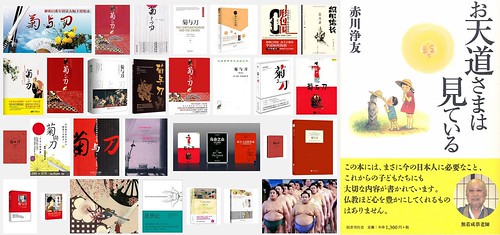
Ruth Benedic's (1946) classic "Chrysanthemum and the Sword" has been popular in China (translated as 菊与刀) selling 70,000 copies in 2005 alone, since it would provide an explanation how the Japanese managed to kill so many Chinese and yet exhibit a level of remorse that the Chinese feel to be very inappropriate. Ruth Benedict's answer is that the Japanese lack a conscience, caring only what other's think about them. A great deal of Japanese believe this theory, which itself originates in a disgruntled Japanese called Robert Hashimoto (Lummis).
More contemporary Japanese detractors of Benedict's theory do not rarely argue that the Japanese do in fact have conscience, under the conventional meaning of that term, but rather that "conscience" in the sense of internal, self-directed, self-reproval simply does not exist. The main reason for this is that they are aware that they judge themselves visio-aesthetically, and this is not something that one can do from inside ones own head. The Japanese forget that the mind is not inside the head -- it is easy to do, I have -- but rather the other way around.
The Japanese are therefore in large part blissfully ignorant of the origin of their own morality, which is, the same as that of the Chinese. Both believe that in addition to the censure of other people, heaven is also judging.
In Japanese parlance the kind old sun is watching (otentou sama ga mite iru. お天道さまがみている。See e.g. Akagawa, 2015) and they'd feel her displeasure should they do anything bad.
This does not explain why the Japanese were able to kill so many Chinese, nor why they do not feel more remorse. In order to understand that one would have to read other books, mainly of a more historical nature.
I hope that the Chinese realise that in fact the Japanese do have a conscience before The Chinese and The Japanese come to blows again.
The images above left are the result of an image search for "”菊与刀” 销量" meaning "sales of 'Chrysanthemum and the Sword'" in Chinese, and the cover of a non-academic book entitled "The Kind Old Sun is Watching" (Akagawa, 2015)
Akagawa, J. 赤川浄友. (2015). お天道さまは見ている. 国書刊行会.
Benedict, R. (1946). The chrysanthemum and the sword; patterns of Japanese culture.
Labels: japanese culture, nihonbunka, occularcentrism, self, specular, 日本文化
"I am, Because you are"

The sign reads "I am, because you are" or "You are, so I am," which is the philosophy of interdependence (Markus & Kitayama, 1981), or ubuntu, in a nutshell.
Note however that this Japanese interdependence is in the world of speech. The second line reads, "Lets hail each other, and thereby, together do our best." This the above is a slogan encouraging greetings such as "good morning" and "g'day" which the Japanese favour even more than Crocodile Dundee. In the world of language, the Japanese subject, their "I" is "you for you" (Mori, 1999, p.163 complete quote again below).
The interdependence of the Japanese visual self is a little more nuanced. The visual self-encourages and requires an awareness of the social nature of self, and interdependence due to the scopic necessity of focusing upon a surface. This ostensible 'externality' convinces even the Japanese that they are out and out collectivists.
But in the Japanese case, they also believe that the 'the kind old sun is always watching' (See e.g. Akagawa, 2015). Their belief gives them a good measure of independence, and Morality with a capital M. Even if 'everyone else is doing it', the Japanese avoid doing things that look bad because the kind old sun can see them, and they'd feel her displeasure should they do ugly things.
Akagawa, J. 赤川浄友. (2015). お天道さまは見ている. 国書刊行会.
Mori, A. 森有正. (1999). 森有正エッセー集成〈5〉. 筑摩書房.
扨(さ)て私は、「日本人」において「経験」は複数を、更に端的に二人の人間(あるいはその関係)を定義する、と言った。それは一体何を意味しているのであろうか。二人の人間を定義するということは、我々(日本人)の経験と呼ぶものが、自分一個の経験にまで分析されていない、ということである。換言すれば、凡ての経験において、それをもつ主体がどうしても「自己」というものを定義しない、ということである。肉体的に見る限り、一人一人の人間は離れている。常識的にはそこに一人の主題、すなわち自己というものを考えようとする思惑を感ずるが、事態はそのように簡単ではない。それは我々において、「汝」との関係がどれほど深刻であるかを考えてみればある程度納得が行くであろう。もちろん「汝」ということは、日本人のみならず、凡ゆる人間にとって問題となる。要はその問題のなり方である。本質的な点だけに限っていうと、「日本人」においては、「汝」に対立するのは「我」ではないということ、対立するものもまた相手にとっての「汝」なのだ、ということである。私はけして言葉の綾をもてあそんでいるのではない。それは本質的なことなのである。「我と汝」ということが自明のことのように、ある場合には凡ての前提となる合言葉のおうに言われるが、それはこの場合当て嵌まらない。親子の場合をとってみると、親を「汝」として取ると、子が「我」であるのは自明のことのように主和得る。しかしそれはそうではない。子は自分の中に存在の根拠をもつ「我」でなく、当面「汝」である親の「汝」として自分を経験しているのである。Mori, 1999. p.163
Labels: culture, japanese, japanese culture, nihonbunka, 日本文化
Monday, July 18, 2016
The Light that Watches and Protects
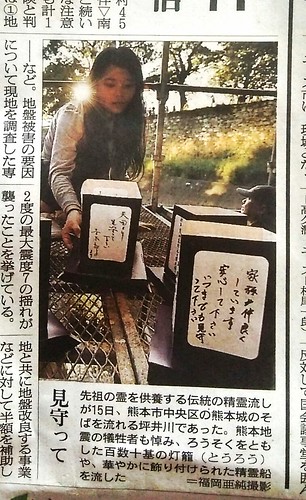
That it seems as if Tiger Woods' head is appearing from a lantern bottom right is a mere coincidence.
*The literal translation is more like "Mister/Madam Sun". The Japanese salutation "sama" is genderless. "Kind old Sun" is a term of respect and endearment for the sun, like the Japanese original, from Wilfred Owen's poem, Futility.
Central image by Azumi Fukuoka. (2016/7/16). Asahi Newspaper. p1.
お取り下げご希望の場合、下記のコメント欄か、nihonbunka.comのメールリンクまで御一筆いただければありがたいです。
Labels: blogger, Flickr, nihonbunka, 日本文化
Sunday, July 17, 2016
Secretary and the Beast by Yuu Takahashi

This post is of an adult, sexual nature.
At the end of the manga, the "beast" of a company boss has very graphically represented relations every which way with his secretary (aslo) male, in the company shower rooms.
The strange thing is that this is part of a genre of comics (bishounen ai or perhasp in this case close to Yaoi) read predominantly by young Japanese girls, perhaps in their late teens. The reason for this, I believe is, that traditionally in Japan it is only female sexuality and desire which is considered taboo, so as long as their are only blokes, then, while smutty and embarassing, there is nothing really bad about it.
Each society hides the harsh reality of the sexual desire that is at its foundation.
Japanese society is based upon rearing children so wombs, whiles and reality of women's desire is hidden. Women appear only as pretty young men.
Western society is based upon horizontal adult to adult "love." (Childrearing is a bit of a "curse.") The above sort of pornography is a mirrored in that which uses lesbians to titillate Western men. In extremis, the male organ and male desire is hidden or completely absent. Men only appear as vorascious lesbians.
Each to each, the ultimate horror, is unhorrible. At the end of the day, this does not bode well for Japanese Western international relations.
おとりさげごきぼうのばあいはnihonbunka.comのめーるりんくまで
Monday, June 27, 2016
Sooth Pilgrimage
Labels: blogger, Flickr, japaneseculture, nihonbunka
Monday, June 20, 2016
Asian Holisim is Happier: And how happy are you?
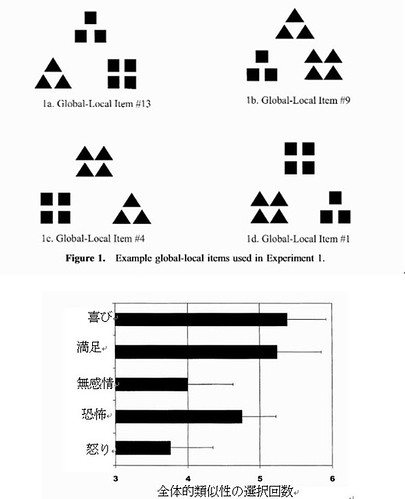
In each of 1a, 1b, 1c and 1d in the above image, which of the two (left or right) figures resembles most the figure above them? This is a test of happiness!
Fredrickson & Branigan(2005)had subjects watch videos of penguins, nature, abstract sticks, a climbers fall, and bullying to promote: pleasure, contentment, the absence of emotion, fear and anger respectively.
Subjects were then shown the four diagrams 1a, 1b, 1c and 1d above which show a single figure above two others and asked which of the two, left or right most resembles the one above. The right hand figure is made up of the same fundamental building block ■ or ▲, whereas the left hand figure is made of the opposite building block but is arranged holistically in the same way as the figure above.
It was found that the more positive emotions resulted in more holistic (left hand) resemblances as per the graph below (with the emotions in the same order as given above). This suggests that those that see the world holistically are happier and those that see it parts, may be in a more negative affective state.
Due to the higher suicide rate in Japan, and naff surveys purporting to guage the well-being of a nation based on one culturally laden question, one is often led to believe that the Japanese are bunch of unhappy people. I think this is very misleading. The higher suicide rate in Japan is due in large part to less negative appraisals of choosing the time and place of ones own death. It is further noted that East Asians in particular and Japanese in general tend to see the world in a more holistic way (Masuda & Nisbett, 2001; McKone et al., 2010). I think that this may be in part because the Japanese are in fact happier.
Fredrickson & Branigan(2005)は、ペンギン・自然・抽象的な模様・登山家の事故とイジメのビデオを使って、喜び・満足・無感情・恐怖と怒りの感情を被験者に持たせ、どれだけ全体的⇔局所的な注意を行っているかを調べた。下記のそれぞれの1a, 1b, 1c, 1dにおいて、上にある形状は下の右か左のどちらに似ているかという質問に対して
全体的局所的
1 a左右
1 b左右
1 c左右
1 d左右
それぞれの4つの設問の下にある2つの形状の右側は、上の物と同じ■か▲かの構成部員からできているから局所に似ているが、左側の形状は構成部員が違っているが全体的には上と同じ三角か四画の配置になっているので全体的に似ている。
その結果
つまり、肯定的感情があるときは全体的な類似性(つまり左側)を選択することが多いです。
Bibliograp;hy
Fredrickson, B. L., & Branigan, C. (2005). Positive emotions broaden the scope of attention and thought‐action repertoires. Cognition and Emotion, 19(3), 313–332. http://doi.org/10.1080/02699930441000238
Masuda, T., & Nisbett, R. E. (2001). Attending holistically versus analytically: comparing the context sensitivity of Japanese and Americans. Journal of Personality and Social Psychology, 81(5), 922. Retrieved from http://psycnet.apa.org/journals/psp/81/5/922/
McKone, E., Aimola Davies, A., Fernando, D., Aalders, R., Leung, H., Wickramariyaratne, T., & Platow, M. J. (2010). Asia has the global advantage: Race and visual attention. Vision Research, 50(16), 1540–1549. http://doi.org/10.1016/j.visres.2010.05.010
Labels: cultural psychology, culture, japanese culture, nihonbunka, 文化心理学, 日本文化
Does the Ladder of Life Exist?

The United Nations publishes a world happiness report based upon data from a Gallup survey, ranking countries according to their level of happiness. The Danes game out top. The Japanese were 53rd, one third of the way down the 150 or so countries, which is irregular bearing in mind their high GDP per capital with which "happiness" is shown to correlate.
It transpires however that the Gallup survey does not measure anything I recognise as happiness at all. The actual, and single, question that determines national happiness is as follows.
“Please imagine a ladder, with steps numbered from 0 at the bottom to 10 at the top. The top of the ladder represents the best possible life for you and the bottom of the ladder represents the worst possible life for you. On which step of the ladder would you say you personally feel you stand at this time?” (From the statistical appendix of the report)
(In my Japanese 「0」という一番下の段から、「10」という一番上の段のある梯子を想像してください。一番上の段は、あなたにとって自分の一番よい人生で、一番下の段は自分の一番悪い人生を表しています。今現在、梯子の何番目の段に立っていると感じるといえるでしょうか?)
While the notion of a variety of lives, and the possibility of my being able to live any other life but the one I am living is a little fraught, it is at least imaginable. I might never have left the UK. I might have married someone else, etc.
As the famous song by Chiyoko Shimakura goes, people lead and we all could have lead a variety of lives. Life is varied. And by implication in the song, while life has its ups and downs, it is all good.
The notion on the contrary that these lives could be ranked and arranged in a vertical hierarchy with the "best life" at the top and "the worst life" at the bottom is far more difficult to grasp. It seems to me that certain negatives accompany positives (such as the envy of others with success), and positives with negatives (such as emotion, and humility with suffering).
That this imaginary vertical ranking of lives transpires to correlate - in most instances - with wealth may be because it is in fact encouraging respondents to economically appraise their own lives, ranking it in quantitative terms -- "I've done okay" "I've done well" -- in none other than in dollars and yen. In any event the suggestion that this one question plumbs the depths of national well-being or that it should be used to guide political policy seems to be to be quite absurd, especially in view of the way in which Westerners answer such questions in so unrealistically positive ways. But alas, this and similar measures are being used to inform political policy and the need for public spending. We are not high enough on the ladder. So, do we need to spend more?
The ladder of life does not exist so we should give up trying to climb it.
The above image contains a detail from a still from Chiyoko Shimakura's video for "Jinsei Iroiro" (Lit "Life Variety" or "Life has its Ups and Downs").
Labels: blogger, culture, Flickr, happiness, japanese, japanese culture, nihonbunka, 日本文化
Tuesday, June 07, 2016
US Doctors are Harder than Salary Men

Labels: attitudes, blogger, fever, Flickr, health, japaneseculture, work
Monday, June 06, 2016
Masked Rider's Icon: Eye-soul

The latest masked rider symbolic transformation item from the 2016 series Masked Rider Ghost (仮面ライダーゴースト) is called an "icon" using the characters for eye and soul (目魂). That the transformation item is some sort of symbol is common to all the transformation items of super sentai (power rangers), ultraman, masked riders, Mirrorman, Mito Kōmon, real members of totemistic tribes such as the Aranda, as well as the symbol collecting Japanese Shinto practitioners. The Japanese traditionally believed they received their soul vectored by a symbol received from shines in the form of shinpu, ofuda,or omamori amulet. Mirrorman, the closest to the Shinto tradition, would transform to his super form thanks to a shrine amulet, while standing in front of a mirror.
That these iconic amulets vector something supernatural from the country of light (Ultraman) is also clear. With this particular symbolic transformation item it is becoming increasing clear that these icons vector an "eye" or perspective such that their wearer or consumer may be transformed into the heroic suit or mask, representing visual appearance. One could only identify with a visual appearance by also internalising another. In the case of masked rider Ghost, these others are heroes such as Isaac Newton, Miyamoto Musashi, and the protagonist's father. Internalising the icon of the father allows the protagonists to internalise the father's eye. The "icon" as "eye soul" pun is Tsuburaya genius.
Another commonality shared by many transformatory symbols, such as Masked Rider Orz Medals, Masked Rider Ghost's Icons, and the Tjurunga or "bull roarers" of the Aranda (I made one) is that they are symbols that make a noise, as if reading themselves. If there were ever a visual symbol that could read itself it would 'prove' that the symbol is not merely formal (arbitrary) but an ontological part of a real world, and perhaps that there is of necessity a third person viewer to read it. Intrinsic icons that combine sound and vision, introduce that gap or distance into the world required for self sight. Icons that can read themselves do indeed therefore contain (or would if such things existed) "eye souls," the eye of the soul, that allow those possessed to transform into the seen.
These symbolic catalysts have the same, but 'Nacalianly transformed,' function as the Lacanian mirror image which is or appears to be a image that sees itself. The Lacanian mirror image, Superman's suit and indeed our own faces, is something that misguides or conceals our whispered identity, but it is also the condition for linguistic self-hood. The catalyst or condition for the linguistic world is that two things are the same. That is the importance of Jackson's red, all the images that Western pilgrims go to see, or the wafer in mass. They prove identity. The catalyst or condition for the visual world is that there is something that is two things, a symbol that reads itself, that can intrinsically be read. The Japanese need to prove an intrinsic distance. Westerners need to prove an intrinsic identity.
Both world views are magical but which is best? Keeping ones symbols on the outside, on ones forehead, or in ones watch or belt, is imho a lot more healthy.
Labels: Bandai, japanese culture, Jaques Lacan, kamenrider, Masked Riders, religion, self, Shinto, Super-Sentai, superhero, スパー戦隊, 日本文化
Tuesday, May 17, 2016
Images of Japanese People

As reported in the Softbank Group's online news paper (ITmedia, 2012), the Japanese advertising and public relations company, Dentsu asked 3772 non-Japanese in 16 regions what they thought of the Japanese.
ソフトバンのオンライン新聞(ITmedia, 2012)電通が16地域の3772人の外国人に日本人に対して持たれているイメージを調査しました。
The results given above show that words associated with the Japanese are predominantly positive despite the fact, it seems to me, the Japanese pay little attention to public relations. Positive associations, such as "creative" were strongest in South East Asian countries, where, I presume, there is especially high consumption of Japanese produced media, such as popular music and manga. Despite the fact that these positive images I rather fear that the Japanese are going to throw all this love away.
上の図に示されている結果では、日本はそれほどPRに注意を払っていないのに、主に肯定的な言葉が思い浮かばれた。「想像的」など肯定的なイメージは、JPOPや漫画など日本のマスメディアが消費されている東南アジアでもっとも高い。こんなに肯定的なイメージがもたれているのに、日本人がこのような日本に対する愛を台無しにするという恐れがあります。
I would like to rate "meek" as positive but I have kept to the positive / negative ratings in the original article. Several of the items, such as "kodawari no aru" which I have translated as "discriminating," were rather difficult to translate. "Solidarity" is short for "have a sense or solidarity" which may be coextensive with words with a negative connotation in the West, such as "conformist" or "a herd." I wonder at how the items were selected and fear perhaps they were selected by the Japanese.
「おとなしい」を肯定的な項目として分類したいですが、元々の記事にあった肯否判断を尊重しました。"discriminating"と英訳してみた「こどなわりのある」などの項目は英訳しにくかった。項目選びはどのように行われていたかはわからず、日本人が選んだ恐れがあると思われます。「連帯間のある」は(Have a sense of)"Solidarity"と英訳してみましたが、「右へ倣え」「群れている」など少なくとも欧米では否定的なイメージのある言葉と重複するとも考えられる。
The Japanese are very interested in what people from other countries think about them since it seems to me, and as argued by Mori (1995), the Japanese lack a linguistic Other and so find it difficult to narrate themselves objectively. The Japanese have instead an autoscopic, mirror-mind, so they know what they look like and that Japan is beautiful.
日本人は一般的に海外でどのように思われているかについての関心が高い。それは森(1995)が論じるように、日本人は言語的な《他者》をもっておらず、自分らを客観的に物語ることが難しいからだと思われる。日本人は反省・自己視的な、鏡としての心をもっているので、自分らがどのように見えるかは日本が美しいということはご存知だと思います。
The original Dentsu News Release can be downloaded from the Dentsu website in pdf form here (in Japanese). The translations are mine.
元々の電通の調査はここからPDFファイルとしてダウンロードできます. 筆者訳.
お取り下げ後希望でありましたら、コメント欄・nihonbunka.comのメールリンクまでご連絡いただければ幸いです。
Mori, 森, 有正. (1999). 森有正エッセー集成〈5〉. 筑摩書房.
Labels: blogger, Flickr, japaneseculture, nihonbunka, 日本文化
Tuesday, May 10, 2016
Mirrors Make Westerners Want to Kill Themselves
According to the central theory of this blog, the "comforter" of the self in Japan and the West observes the self in a different media. In either case the comforter is based upon the mother. Before we become aware of our mirror image or our names we identify our subjectivity with that of our mother and later learn to see (Japanese) or hear (Westerners) ourselves as an object of her subjectivity or in her frame of reference. In Japanese, more matriarchal society the mother looks and the self is seen. In the West the mother is more passive, she listens. Self expression in the dominant medium of self expression is enjoyable and enhanced, and self expression in the non dominant medium is in each case fraught. Japanese enjoy taking pictures of themselves, posing, and "making (visual corporeal) things". Westerners love expressing themselves, shooting their mouth off, and (as I am doing now) making up theories.
本部論の主たる理論によれば、日本や欧米における自己の慰安者は異なる媒体において自己を傍観している。いずれの場合でも慰安者は母に由来する。自分を物語り、鏡の中で確認できる前に自らの主観を母と同感同一視し、後に母の主観・母の間のなかで自分らを見て(日本)、あるいは聞く(欧米)。より母性原理の強い日本においては母は観る、自己は観られる。欧米での母はより受動的で聞くものとされる(Freud)。主たる優位にある媒体における自己表現は快楽的ですが、それぞれの文化の劣位にある媒体における自己表現は居心地悪い。日本人は自撮りやポーズをとることが好きで、(視覚的な)物づくりを得意とする。欧米人は言語的自己表現や偉そうに話すことも、理論を作ることがすきです。
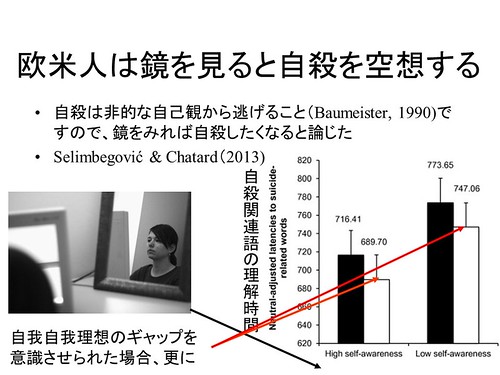
Japanese have a problem with linguistic self expression and Westerners have a problem with mirrors. Baumeister (1990) theorised that mirrors would increase the desire to escape from self in the most drastic way: suicide. Selimbegović & Chatard(2013) demonstrated this greater tendency towards suicide by testing the amount of time before subjects were able to recognise suicide related words (suicide, rope, wrist, hang, and attempt from nonsense words) in front of a mirror and in a control condition. It was found that subjects became quicker at recognising these words in front of the mirror and that this effect increased when the subjects were encouraged to think about how far they were from their own ideals.
一方、日本人は言語的自己表現が億劫で、欧米人は鏡が嫌い。Baumeister(1990)は鏡を見る欧米人は、「自己から逃げる」最も極端な手法である自殺に走らせると論じた。Selimbegović & Chatard(2013)は、自殺関連語(自殺・紐・手首・[首]吊り・未遂)をナンセンス語から見分けるまでの時間欧米の被験者において鏡の前で早くなるということで、自殺願望への傾向向上を示した。自我と自我理想のギャップを石示唆せられた被験者において鏡の効果がさらにつよくなりました。
In Japan mirrors are used on train platforms to prevent suicide. In the West telephones are used in same way but, as Butler (Butler, Lee, & Gross, 2009) demonstrates, linguistic expression tends to make Japanese MORE stressed.
日本では駅のホームでは鏡は自殺予防に一約を担っていますが、アメリカの自殺名所では電話が設置されます。Butler (Butler, Lee, & Gross, 2009) が示すように、日本が言語的表現をさせられると逆にストレスが増えます。
The recent use of telephones at Japanese suicide spots and Abe's initiative to make all 100 million Japanese verbalise their objectives and become "active" like Westerners (!) is from this perspective, a very bad idea. 日本の自殺名所での電話の設置や、日本人が自分らの行動を言語化し活躍する一億人総括という安倍首相の政策は、上述の立場から考えれば、名案だとは言えないと思われます。
www.flickr.com/photos/nihonbunka/11959516956
Bibliography
Baumeister, R. F. (1990). Suicide as escape from self. Psychological review, 97(1), 90.
Butler, E. A., Lee, T. L., & Gross, J. J. (2009). Does expressing your emotions raise or lower your blood pressure? The answer depends on cultural context. Journal of Cross-Cultural Psychology, 40(3), 510-517.
Selimbegović, L., & Chatard, A. (2013). The mirror effect: Self-awareness alone increases suicide thought accessibility. Consciousness and cognition, 22(3), 756-764.
Labels: japanese culture, nihonbunka, 日本文化
Saturday, May 07, 2016
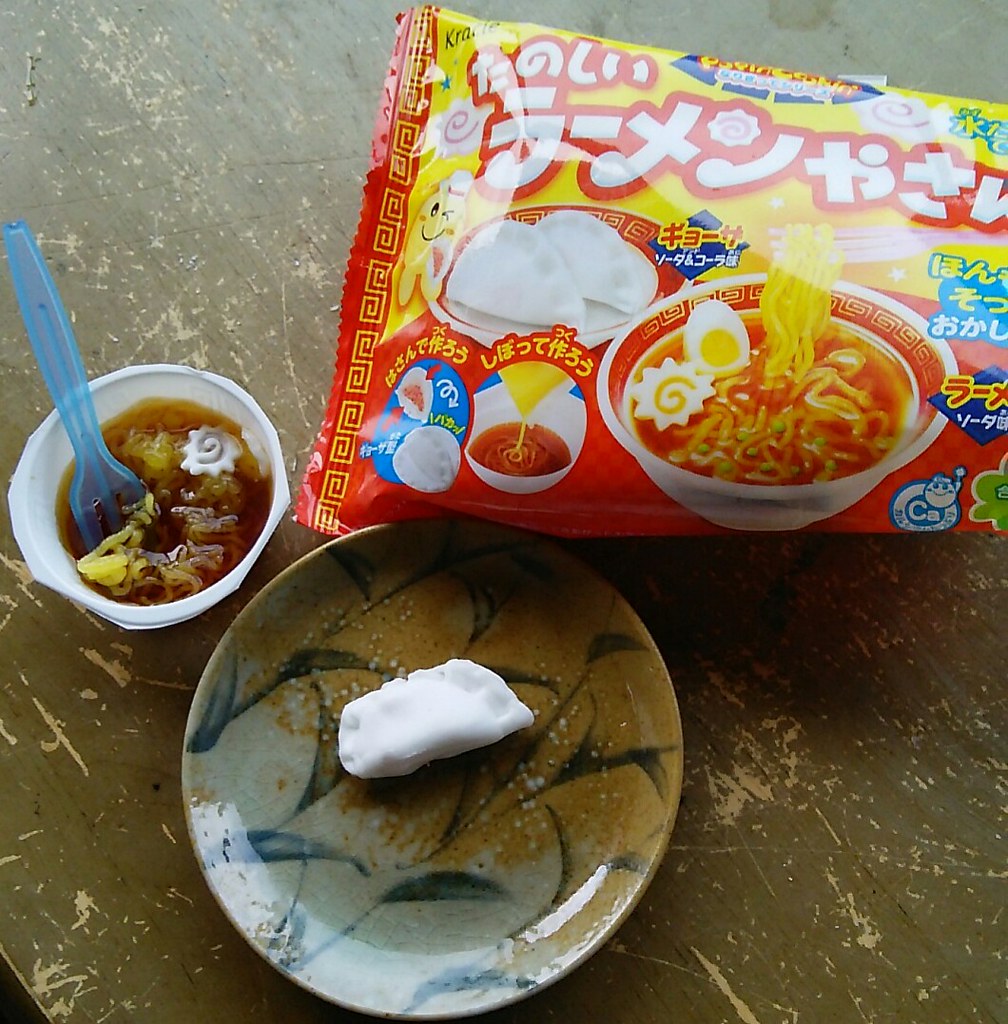
Fun Ramen Restaurant
Labels: blogger, Flickr, japaneseculture, nihonbunka
Tuesday, April 26, 2016
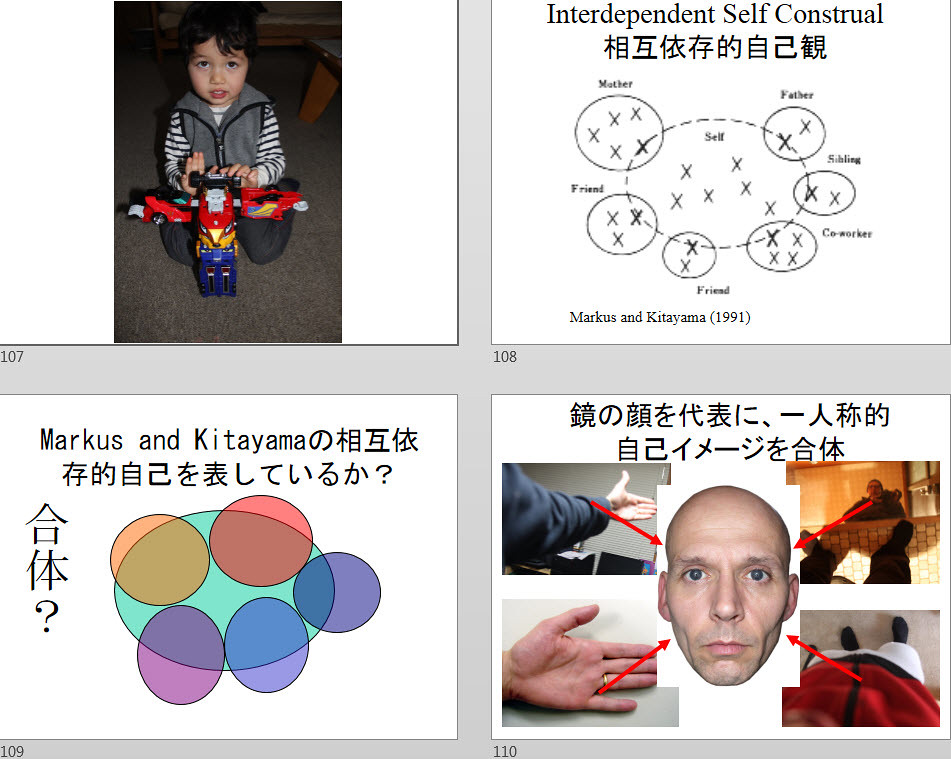
Two Reasons For Gattai
Labels: blogger, Flickr, japaneseculture, nihonbunka, sentai, superhero, 日本文化
Thursday, April 21, 2016
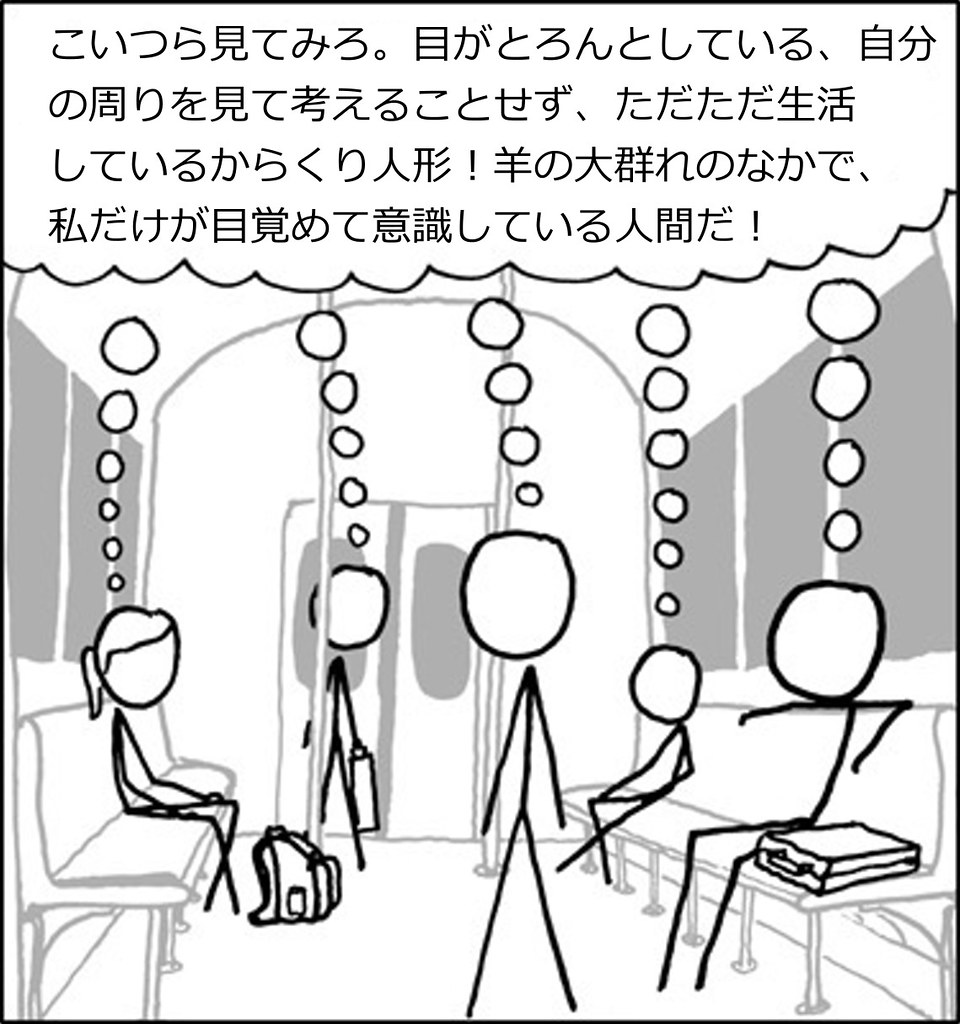
Japanese Translation of Sheeple
Labels: blogger, culturalpsychology, Flickr, japaneseculture, nihonbunka
Tuesday, April 19, 2016
Spring Night's Dream
Labels: blogger, Flickr, japaneseculture, nihonbunka, 日本文化
Wednesday, April 13, 2016
Will Jim be Helpful?
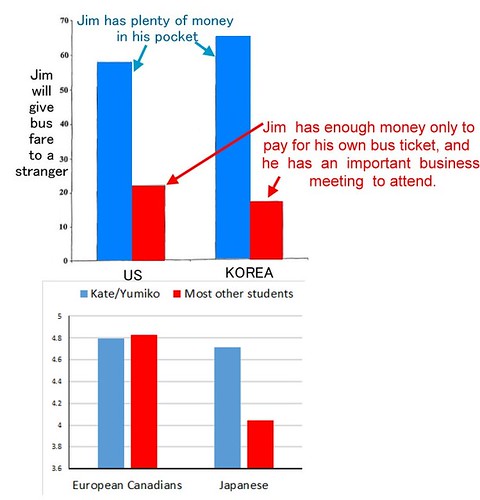
Choi, Nisbett, and Norenzayan (1999) that when Americans and Korean's were asked whether an individual, "Jim", would help a stranger in the situation where Jim either has plenty of money in his pocket, or where Jim has money only enough for his own fare and an important meeting to go to, the Koreans were found to be more influenced by the situation as in the above graph (based upon Choi, Nisbett, & Norenzayan, 1999, fig. 1. p. 52). It is argued that Asians are more contextual basing their decisions, and predictions of other's decisions, upon the context of the action rather than the character of the individual.
The experimental evidence is persuasive, and it fits in with stereotypes of East Asian "collectivists", lacking gumption, blown by the winds of societal, and contextual pressure.
At the same time, there is something wrong with this picture. Firstly I find that Koreans and Japanese are notably helpful, and non violent, to strangers across situations rather than showing behavioural swings, the helpful to mean, as shown in the graph above.
I suspect that there is another reason why the Koreans are being more "context" sensitive and that is that they are given no information about Jim other than his name. If the Koreans were given an equal amount of information regarding Jim, such as "Jim is a suited 25 year old business man working for a provincial bank", say, then the they would have been no more swayed by the context than the Americans because they, like the Japanese, base their decisions upon what they can imagine, animating the visio-imaginable rather than the phoneme "Jim".
In support of this hypothesis in other research it was found that when given a little more information ‘‘Kate (Yumiko in Japanese) age 20, is a student at your university," (Hamamura, Heine, & Takemoto, 2007, p.250) was given to Japanese and Canadian students, it was the Japanese and not the Canadians that gave a more outlier - further from "most other students" - appraisal of ‘Kat/Yumiko's personality (graph above bottom, based on Hamamura, Heine, & Takemoto, table 1). This difference was significant (p<.001). This is because, I believe, in this experiment the subjects were not just given a name, but also some information upon which to imagine the person that they were appraising.
The Japanese mind does not make decisions in words (Kim, 2002), but upon the surface of its mirror (Timothy Roland Scott Leuers = Takemoto & Sonoda, 1998, 2000; T.R.S. Leuers = Takemoto & Sonoda, 1999; T. Leuers = Takemoto & Sonoda, 1999; Takemoto, T., 2002, 2003; T. Takemoto, n.d.; Timothy Takemoto, 2011a, 2011b, 2012a, 2012b, 2014).
Choi, I., Nisbett, R. E., & Norenzayan, A. (1999). Causal attribution across cultures: Variation and universality. Psychological Bulletin, 125(1), 47. Retrieved from citeseerx.ist.psu.edu/viewdoc/download?doi=10.1.1.316.410...
Hamamura, T., Heine, S. J., & Takemoto, T. R. (2007). Why the better-than-average effect is a worse-than-average measure of self-enhancement: An investigation of conflicting findings from studies of East Asian self-evaluations. Motivation and Emotion, 31(4), 247–259. Retrieved from link.springer.com/article/10.1007/s11031-007-9072-y
Heine, S. J., Takemoto, T., Moskalenko, S., Lasaleta, J., & Henrich, J. (2008). Mirrors in the head: Cultural variation in objective self-awareness. Personality and Social Psychology Bulletin, 34(7), 879–887. Retrieved from www2.psych.ubc.ca/~heine/docs/2008Mirrors.pdf
Kim, H. S. (2002). We talk, therefore we think? A cultural analysis of the effect of talking on thinking. Journal of Personality and Social Psychology, 83(4), 828. Retrieved from labs.psych.ucsb.edu/kim/heejung/kim_2002.pdf
Leuers = Takemoto, T. R. S., & Sonoda, N. (1998, October). 心像的自己に関する比較文化的研究(1) Cross Cultural Research on the Specular Self. Oral Presentation口頭発表 presented at the The 62th Annual Convention of the Japanese Psychologiocal Association English日本心理学第64回大会, Tokyo Gakugei Daigaku. Retrieved from nihonbunka.com/docs/shinzoutekijiko1.doc
Leuers = Takemoto, T. R. S., & Sonoda, N. (1999). Independent self bias. Progress in Asian Social Psychology, 3, 87–104. Retrieved from httyp://www.nihonbunka.com/docs/independent_self.rtf
Leuers = Takemoto, T. R. S., & Sonoda, N. (2000, November). 心像的自己に関する比較文化的研究(6) -メディア(言語とイメージ)の違いと日米比較― Cross Cultural Research on the Specular Self: Differences in Media (Language and Image) and comparison between Japan and America. Oral Presentation口頭発表 presented at the The 64th Annual Convention of the Japanese Psychologiocal Association English日本心理学第64回大会, Kyoto University. Retrieved from nihonbunka.com/docs/shinzoutekijiko6.docx
Leuers = Takemoto, T., & Sonoda, N. (1999). The eye of the other and the independent self of the Japanese. In Symposium presentation at the 3rd Conference of the Asian Association of Social Psychology, Taipei, Taiwan. Retrieved from nihonbunka.com/docs/aasp99.htm
Takemoto, T. (2002). 鏡の前の日本人. In 選書メチエ編集部, ニッポンは面白いか (講談社選書メチエ. 講談社.
Takemoto, T. (2003). 言語の文化心理学―心の中のことばと映像(The Cultural Psychology of Language: Language and Image in the Heart). In 武本, ティモシー & 古賀,範理, あなたと私のことばと文化―共生する私たち―. 五絃舎.
This blog represents the opinions of the author, Timothy Takemoto, and not the opinions of his employer.