
Monday, July 27, 2015
Hoopa: The hooper that that could not loop
I thought "Pokémon the Movie: Hoopa and the Clash of Ages" was a Japanese commentary on Western culture personified in "Hoopa, the hooper that could not loop" (my subtitle).
Hoopa has two forms (as do many Pokémon), and as are believed to exist in the Buddhist view of ourselves: the small (unenlightened) and large (enlightened) self. We see the giant form of Hoopa first who uses giant hoops to move (or steal) things from anywhere in the world. Hoopa's power rests in this telekinetic ability. Herein lies the first parallel with Western culture. The Japanese have a bit of a tendency, in my limited experience, to see the British and their descendants as thieves, or "vikings" as they tactfully put it, conquering the world and taking it home. The seven hoops of Hoopa (one around each of his six arms, and one around his waist) may correspond to the sense of Buddhism (although there is one too many) which include the sense of the heart. From some Japanese points of view Westerners look upon nature and the world as a source of things to take, rather than as something with which one feels in harmony, to an extent unified.
Hoopa finds himself internally conflicted and unable to evolve into his large self who remains trapped in a bottle by a religious organisation that bears more than a passing resemblance to Judeo-Christianity. From a Japanese perspective Western culture separates God and humankind whereas in Japan, the enlightened, a supreme martial artist for instance, becomes one with God or the Buddha - which tend to be seen as the same things.
This inability to evolve into his large self, and being in conflict with it, parallels Hoopa's inability to pass through his own hoop. As we have seen Hoopa has six hoops (plus one around his body) that he uses to move or plunder the cosmos. He seems partially able to pass through one of his hoops (the one around his middle) but unable to pass through any of his others.
This inability to pass through his own hoops is due to Hoopa's lack of gratitude. Through his experience of growing up once again as small Hooper, however, Hoopa learns to love and feel gratitude and finally, when he does this he is able to pass through one of his own hoops. In this sequence, before the triumphant auto-looping-hooping the hoop, and overcoming self-conflict, Hoopa imagines himself growing up and all the love he has received. This introspection - literally seeing himself - works on a lot of levels as the defining characteristic of Japanese culture. The Japanese believe their heart to be a mirror, are found to literally have a mirror in their heart, they are (through the practice of Noh and Karate forms) able to see themselves from a perspective outside, and use this ability to see themselves from the points of view of others. Autoscopy is also especially noticeable in the last letters of suicide pilots and the Japanese version of psychoanalysis: Naikan therapy.
This self-seeing, or self perception may be what the whole "Pocket Monster" mythology is about as represented by the Pikachu Satoshi Diad. There is a monster within us, sitting on our shoulder, who sees us, but at some level, or in some way, Satoshi and Pikachu are one. Perhaps in a final Pokémon movie this fact will be revealed. Or perhaps it already has. I have only seen two Pokémon movies.
Reading perhaps far too much into the iconography, it seems proper that Hoopa should be appear from out of one of his hoops (little Hoopa), have hoops on his ears (little Hoopa) or have one of his hoops as a hole at his centre (Big Hoopa) since Westerners do feel able to perceive themselves, linguistically. Only being able to perceive ourselves through this especially dark mirror, we are able to wreck destruction on an unparalleled scale, believing that anything that can be linguistically justified is acceptable. Hence a Briton feels able in saying that the British enforced importation of narcotics into China, for more than a hundred years, was acceptable because "the Chinese chose to smoke (opium). Or, in my experience, Americans (and others from the allied nations) generally continue to approve of the bombings of Hiroshima and Nagasaki, as just since 'the Japanese started it.' It is only when one starts to see oneself, hear the crying children, smell the stench of results of what one does, it is only when one passes through other hoops, that such justifications become untenable. We need to learn other forms of insight fast.
Hoopa learns gratitude, becomes able to perceive himself, is no longer conflicted, walks in the light, or becomes Japanese, in harmony with, not apart from the world. In the last part of the movie giant Hoopa spends his time rebuilding that which he has destroyed, only plundering the occasional doughnut.
I was moved by the compassion with which Hoopa the destroyer was viewed. Even though he destroyed the humans that fed him, Hoopa was not punished with death, but merely part of him kept in a bottle, since after all, as grandfather says, Hoopa is one of the family.
(I have a Japanese family, and lack gratitude, so this notion moves me to tears.)
Labels: autoscopy, cultural psychology, culture, japan, japanese, nihonbunka, occularcentrism, self, specular, 日本文化


Tuesday, July 21, 2015
Japanese Repression of Proactive interference
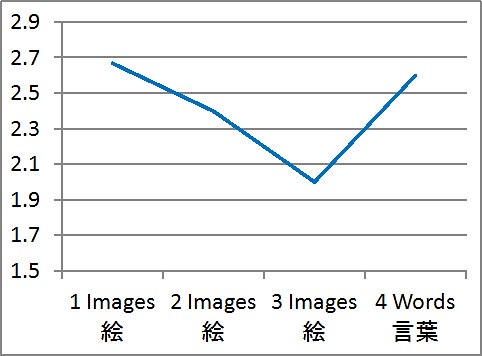
There were only 10 subjects and I did not manage to explain the test too well so three subject did *worse* in the first trial but there was successive proactive inhibition as the subjects were given memory tests on sets of three modes of transport as icons, and a release from proactive inhibition on the forth trial when that fourth trial used words as opposed to icons as used on the previous three trials.
That Westerners gain a release from proactive inhibition when they are shown a fourth trial with pictures, but not a fourth trial with words, following pictures, (Hopkins, et al. 1973) is due to the fact I believe that Westerners will chant (Vygoski) the words for the pictures that they are shown so showing pictures uses up their short term memory for words. Japanese however, as demonstrated by Kim (2002) do not speak to themselves when they are shown visual problems, so when the fourth trial is words (as above) then their short term memory for words is not proactively inhibited.
I also predict the reverse reversal, wherein Japanese will not experience a release from proactive interference when they are presented with a sequence of words to remember followed by pictures because when presented with words they will supply the pictures, "chanting" or rather imagining, or flashing them to their internal-external other.
The Japanese Other is internal-external. It is inside the Japanese psyche but outside the Japanese head since it can see their face, and yet has X-ray eyes because it can see their imaginings, underwear, truck "madonna" and car interiors.
I wrote all the following before then deleted it by mistake. What follows (who cares!) is a rehash.
There are phenomenological or (proto?) physical limits to self deception. The important point is deception.
But there are ways that one can deceive oneself that seem (to me now) to be governed by almost Kantian "proto-physical" or "phenomenological" imperatives due to the difference between eyes and ears: eyes can be seen but ears can not normally be heard because they do not make sounds.
There are therefore proto-physical, or phenomenological facts that limits the extent, and ways in which one can deceive oneself.
I can not deceive myself into thinking that I am seen from any other than an external (e.g. on my shoulder, Pika!) view point. On the other hand, I can deceive myself into thinking that I am heard from an internal ear-point. I can believe that the ear of the other is inside my head.
Ears are more passive than gazes since eyes participate in the world of sight, whereas ears are not heard.
Perhaps the grammatological requirement that there be a subject if there is an object is of the same order as the above phenomenological limits to deception.
Kim, H. (2002). We talk, therefore we think? A cultural analysis of the effect of talking on thinking. Journal of Personality and Social Psychology.
doi.org/10.3758/BF03208905
Hopkins, R. H., Edwards, R. E., Tamayo, F. M. V., Holman, M. A., & Cook, C. L. (1973). Presentation modality and proactive interference in short-term retention using a mixed-morality distractor task. Memory & Cognition, 1(4), 439–442.
link.springer.com/article/10.3758%2FBF03208905
Wickens, D. D. (1973). Some characteristics of word encoding. Memory & Cognition, 1(4), 485–490. Retrieved from link.springer.com/article/10.3758/BF03208913
Tuesday, July 14, 2015
Western Release from proactive interference
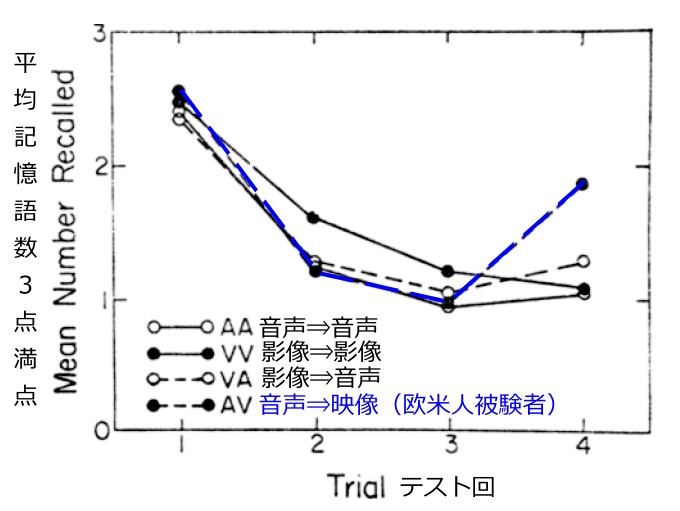
"Release from proactive interference" (Wickens, 1973) describes the way in which after a series of similar memory tests one is given a novel set of items to remember, then ones short term memory returns almost to fresh, first test or second test levels, since the novel stimuli are not confused or "interfered with" by the previous tests sets.
"Release from proactive interference" between visual and audio modalities, mentioned previously, is only found, in Western subjects, when moving from audio to visual stimuli and not when moving from visual to audio stimuli (Hopkins, Edwards, Tamayo, Holman, & Cook, 1973).
In other words, if Western subjects are given three memory tests with three pictures of fruit followed by a memory test using fruit words, their performance does not return to previous levels.
But if Western subjects are given three tests using fruit words, and an a fourth with pictures of fruit their performance does improve to previous levels.
The reason for this asymmetry may be due to the fact that, even when shown pictures of fruit, Western subjects are likely to think, or hear themselves speak (Derrida), the words for the fruit, so that their short term memory of fruit words is being depleted ('proactively interfered' with) even in the visual pre-test condition.
In the case where Western subjects are first given fruit word memory tests however, the Western subjects may not generally imagine the fruit corresponding to the fruit words, so if on the fourth trial they are shown fruit images, these images are felt to be novel stimuli, that are not "proactively interfered" with by the previous verbal trials.
I predict that Japanese may show the reverse pattern in that moving from audio fruit words to visual fruit pictures may not result in a "release from proactive interference" since in the audio condition Japanese may imagine the fruit that is presented in words.
However in the visual pretest condition, the Japanese may not bother to say the words for the fruit to themselves (see Kim, 2002 for evidence), so if the fourth trial is of fruit words, then they may show a release from proactive interference -- an improvement in recall -- since the fruit words will be felt to be novel stimuli.
This would be easier to test than self-related stimuli.
The test response method (getting subjects to say or draw the fruit) and distractor task between trials (getting subjects to add visually and verbal presented digits) may also confound results.
Interestingly a mixed audio and visual filler task (adding visually presented digits) produced the same results as an audio tasks adding orally presented digits. Again, I think that this is because Western subjects would be likely to self-speak the images of digits, so images are always mixed mode for Westerners. Following the reasoning in Kim (2002) the same may not be the case in Japan. According to a Nacalian transformation, a mixed filler task would be equivalent to a visual filler task since Japanese will provide the visuals when presented with oral stimuli. Oral stimuli are likely to be always mixed mode for Japanese.
I wonder if there is pre-existing Japanese research on this paradigm, and whether a reversal has already been found. Or whether the same tendency was found. No this paper (Hopkins, Edwards, Tamayo, Holman, & Cook, 1973) seems to be cited only three times, and only by researchers in the West. Searching for the authors surnames and Japanese keywords likewise yields no hits.
Addendum
There is some Japanese research by Tadashi Fujita (Fujita, 1995; 藤田正, 1985, 1988) and the results are not good from the point of view of my hypotheses.
In the main the research I have found is not testing audio visual modality shifts and repression of proactive inhibition but in the one article which did investigate modality (Fujita, 1995), to a degree, by looking at the way in which kanji characters interfere with each other, it was found that similar kanji pronunciations do result in proactive interference (suggesting that Japanese do not process kanji by image alone, as is well known) whereas different pronunciations result in a release from proactive inhibition. And even worse for my hypothesis, changing the radical of kanji did not however result in a release from proactive interference, whereas semantic differences between tests did. This suggests, contra my hypotheses, that Japanese are thinking in phonemes and semantics (meaning) more than purely in kanji morphology. In a more recent paper (Fujita, 2007) it was found that Japanese (kun) reading of the kanji has more effect than the Chinese (on) reading.
I would be more interested to know what happens when Japanese remember non linguistic images or icons, other than kanji. Fujita's research used a different methodology, with successive tests being in the same or different groupings rather than three tests in the same followed by one in a different group.
Bibliography
Fujita, T., & others. (1995). Buildup of proactive interference in Japanese Kanji learning. Retrieved from near.nara-edu.ac.jp/handle/10105/703
藤田正. (1985). 順向抑制の形成に及ぼすリスト類似性の効果. Retrieved from libneardspace.nara-edu.ac.jp/handle/10105/2221
Fujita, T. 藤田正. (1988). 順向抑制の形成に及ぼす隣接試行の類似性の効果. Retrieved from dspace.nara-edu.ac.jp/handle/10105/2042
藤田正. (2007). 訓主漢字と音主漢字の記憶における分散効果. Retrieved from dspace.nara-edu.ac.jp/handle/10105/637
Hopkins, R. H., Edwards, R. E., Tamayo, F. M. V., Holman, M. A., & Cook, C. L. (1973). Presentation modality and proactive interference in short-term retention using a mixed-morality distractor task. Memory & Cognition, 1(4), 439–442.
link.springer.com/article/10.3758%2FBF03208905
Kim, H. (2002). We talk, therefore we think? A cultural analysis of the effect of talking on thinking. Journal of Personality and Social Psychology.
doi.org/10.3758/BF03208905
Wickens, D. D. (1973). Some characteristics of word encoding. Memory & Cognition, 1(4), 485–490. Retrieved from link.springer.com/article/10.3758/BF03208913
Labels: cultural psychology, culture, japan, japanese, japanese culture, nihonbunka, 日本文化
Thursday, July 02, 2015
A You for You and An Eye for an Eye
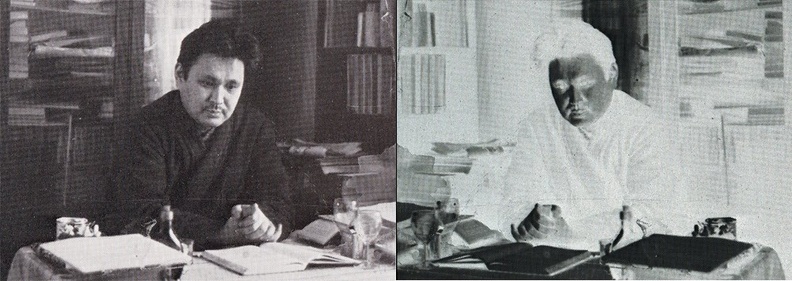
One of the simplest Nacalian transformations that I have yet to fully expand upon, is that of Mori Arimasa's theory of the Japanese first person pronoun. I have said most of this before, but I have not yet expressed the the rather bemused way in which Japanese view Western faces, or how we should conceptualise our faces in a Japanese frame of mind.
Mori argued that the Japanese first person pronoun is expressed in a variety of forms, in a variety of forms of language that always binds it into binary relationships with its interlocutor you, such that, expressed in a French frame of mind, the meaning of "I" in Japanese is merely "a you for a you" (汝の汝).
One half of Nacalian transformation of Mori's theory has, and had, already been argued by Lacan. Lacan argued that infants identify first with mirror images and as they mature, with their the first person of their self narrative. This progression is inevitable and desirable, Lacan claims, since in the "mirror stage" humans are locked into binary relationships with mirrors and others since the face is only face for another face, or rather in the same way that the Japanese I is (according to Mori, who was surely influenced by Lacan) another interlocutor for its interlocutor, the Western face is locked into a relationship with its 'visual interlocutor' or spectator. The Western face is in other words, just an eye for an eye. Just as the Japanese only hear their first person pronoun through the ears of the second person that they are addressing, Westerners can only see our eyes via mirrors or through the eyes of another. Lacan and Mori (and Bakhtin, Mead, Freud etc) further argue that, in France at least, language provides a third person perspective enabling Francophones to have an I which is objective.
The missing part of this "Nacalian" (Lacan backwards) transformation is my assertion that in Japan, the face is not merely a visual interlocutor for another interlocutor but felt to be observed by a third person generalised other (Senken no Me, Otentousama) that frees the Japanese face, and persona or self, from dependence upon binary relationships.
In each case the achievement of these freedom comes at a price. First of all, we are no longer our true selves. And futher, Derrida and I (!) argue that this extra other, in the West "The Ear of the Other," is uncanny (unheimlich): something once familiar that is now horrific and repressed (Derrida, 1985, p33), repressed and horrific.
Bearing in mind that Western faces are like eyes for eyes, it should appear to the Japanese that our faces are dependent upon the binary relationship in which we find ourselves. Indeed this is the case that Japanese perceive Westerners as always making rather grotesque (oogesa na) "faces" (and gestures) whereas their own facial expressions incline towards remaining objective, and 'composed'.
Bearing in mind that the objective and subjective is reversed - that is to say that the power relationship between the visual and the linguistic is reversed - leads to world views turned inside out, with completely different notions of time, space, travel, tourism and morality.
I prefer the Japanese method of self-reflection since I believe that that vision is somewhat less prone to "spin" or the self-enhancement that Westerners are so good at, and because matriarchy is more natural and effective than patriarchy. Indeed, patriarchy seems to me to be a sort of deviant version of matriarchy, where men somehow worked out how to use some of the natural control methods of matriarchs.
Image: kajap.hypotheses.org/450
Labels: blogger, Flickr, japaneseculture, nihonbunka, self, tourism, 日本文化
Monday, June 29, 2015
Complete Absence of Graffiti in Japan

The Ruth Benedictine notion, supported by almost every other scholar of Japan culture, that Japanese moral behaviour is a form of image maintenance geared towards protecting and maintaining their good image in the eyes of others is given lie by the complete almost absence of graffiti in Japan. British and American university toilets are scattered with generally lewd and or offensive, and sometimes amusing, graffiti. But even though the Japanese are at least as good at pictorial art and as witty, and at least as begrudging of their teachers such as me, there is a complete absence of graffiti in all the cubicles in Yamaguchi University, including the one nearest my research room. If this were a British university there would be a giant bald head with a slit down the middle.
The Japanese think they are just being Collectivist
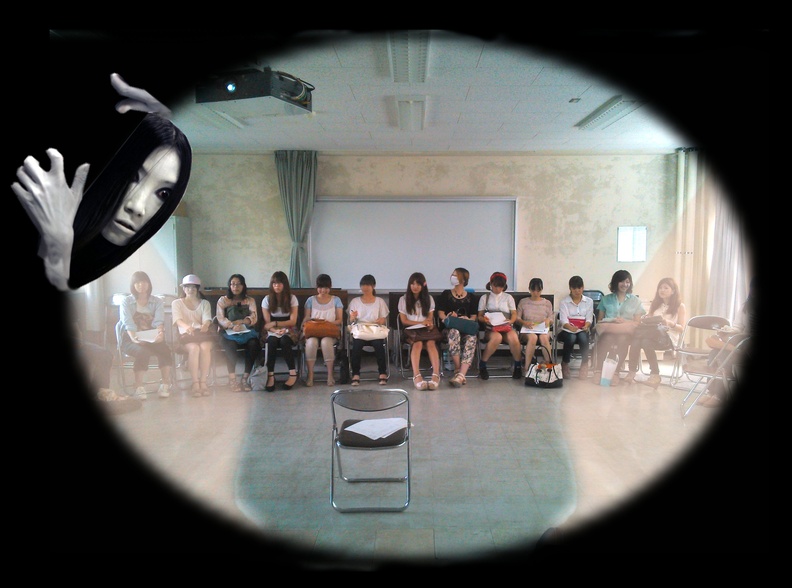
The Japanese think that they are being collectivist but there is one simulated autoscopic gaze whose x-ray eyes they can cannot meet. Likewise, we Westerners think that we are only speaking to ourselves and our absent friends but there is one ear that we ignore. Paraphrasing Archimedes, "Give me a place to stand on, and I will make the Earth." Just one subject position hidden: that is all it takes to believe in a visual, or verbal (Kantian, ideal) world.
The need to hide the superaddressee is the reason why Westerners think they are individualists and Japanese think that they are collectivists. The horrific other can be hidden, as well as by being horrific, in one of two ways.
If the superaddressee is an ear then it can't be hidden publicly since one would need to go around talking out loud all the time. This is what children do at first (c.f. Vygotsky) but the content of the chanting that they do is too weird for them to keep doing it out loud. Once they start doing it quietly it does not take long before they think that they are talking purely and simply to themselves (but as Vygotsky demonstrates, children still in the talking out loud stage give up if put in a room full of foreign language speakers). Since we Westerners kid ourselves that we are talking only to ourselves, we claim that we are individualists. Individualism is a lie that helps keep the sin, that is so horrific, hidden.
If the superaddressee is an eye, then it emphasises its own duality be requiring space, or a gap, between the see-er and seen. The way that phonemes require a temporal gap is less obvious. Westerners imaging that it is possible to understand the living word in mind even as it is spoken in immediate "presence." To hide their sin, which is not nearly so disgusting since the superaddressee is less passive, the Japanese claim that they only care about the eyes of others. This allows them to forget that they are posturing to vast and scary Starman, or sun goddess. While, however, individualism is a lie since meaning is always transitive, it is in fact possible to be collectivist. In this situation the Japanese mirror is clean; the abject feminine can be washed from it. For this reason I believe, it may be necessary to be born again, as a Japanese, in the sense of someone who lives in the light, in order to be saved from the beast!
Kayako Saeki pictured above, always looks like she is trying to get out of the image, because like Sadako, she is. Furthermore she is not really modelled as a member of the crowd, with a face that can be seen from the front, but rather as or in the boundary of experience: the first person view of the subject. The Japanese, I believe, look out of her eyes. She is especially difficult to see because East Asians have smaller, invisible, noses like Gachapin!
Image of Kayoko Saeki copyright Aiko Horiuchi and Ghost House Pictures / Vertigo Entertainment
Labels: autoscopy, horror, japanese, taboo, tabuu, ホラー, 日本文化
The X-Ray Eye in the Sky
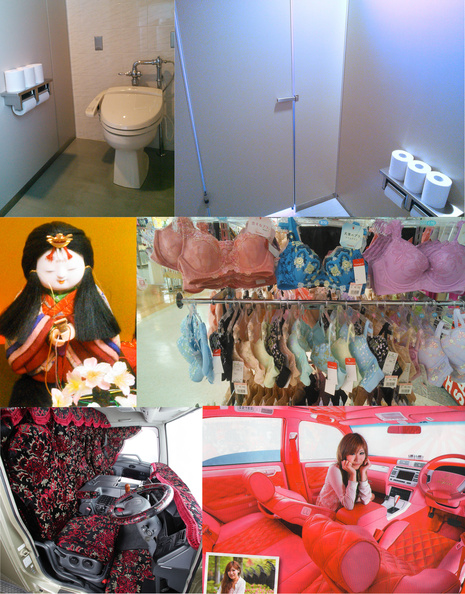
Ball and Torrance (1978: see Kim, 2002) demonstrated that the Japanese can visualise inside things. Since as demonstrated by our research they have a sort of mirror in their heart (Heine, Takemoto, Moskalenko, Lasaleta, & Henrich, 2008) their internal visualisation ability applies to their underwear, car interiors and hearts. This self directed eye is not something that the Japanese are fully aware of, but is rather the eye of the Other of the Japanese self, their super-ego which also prevents them from writing graffiti in toilet stall, or robbing people even in the dark. The eye in the Japanese sky sees inside things, and in infra-red too, but perhaps not quite so well. Tthe Japanese do tend to get a little more boisterous at night, and there is a division of what one is and is not allowed to do before and after sundown - specifically drink alcohol.
Image bottom left from Vip Style Magazine (July, 2015) p. 131
Image bottom right copyright 株式会社雅
お取り下げご希望でありましたら、下記のコメント欄かnihonbunka.comまでご連絡ください。
Ball, O. E., & Torrance, E. P. (1978). Culture and Tendencies to Draw Objects in Internal Visual Perspective. Perceptual and Motor Skills, 47(3f), 1071–1075. doi.org/10.2466/pms.1978.47.3f.1071
Heine, S. J., Takemoto, T., Moskalenko, S., Lasaleta, J., & Henrich, J. (2008). Mirrors in the head: Cultural variation in objective self-awareness. Personality and Social Psychology Bulletin, 34(7), 879–887. Retrieved from www2.psych.ubc.ca/~heine/docs/2008Mirrors.pdf
Ball, O. E., & Torrance, E. P. (1978). Culture and Tendencies to Draw Objects in Internal Visual Perspective. Perceptual and Motor Skills, 47(3f), 1071–1075. doi.org/10.2466/pms.1978.47.3f.1071
Heine, S. J., Takemoto, T., Moskalenko, S., Lasaleta, J., & Henrich, J. (2008). Mirrors in the head: Cultural variation in objective self-awareness. Personality and Social Psychology Bulletin, 34(7), 879–887. Retrieved from www2.psych.ubc.ca/~heine/docs/2008Mirrors.pdf
Labels: authenticopy, japanese, japanese culture, nihonbunka, 日本文化
Outside Black Interior Pink

If you tried to have a conversation with this lady you might mistakenly think that she is alll and humble lacking in individuality. She has dressed up her car interior in vivid pink, leaving the outside black with only a hint of weird. The Japanese have an X-ray eye that can see even into their hearts. No Japanese can meet its gaze and live.
Vip Style Magazine (July, 2015) p. 131
お取り下げご希望でありましたら、下記のコメント欄かnihonbunka.comまでご連絡ください。
Labels: autoscopy, horror, japanese, japanese culture, nihonbunka, occularcentrism, ホラー, 日本文化
Thursday, June 25, 2015
Shame and the Male Gaze

The image on the left is from a book recommending Nudism to Westerners, in an attempt to "grow up without Shame". The genitals have been by me blurred to conform with current Japanese law. The image on the right is from Nakao (2010) "Since when did the Japanese find being naked embarrassing" and is one of the sketches by Heine in Admiral Perry's impressions of Japan at the end of the Edo period. According to Nakano (2012) and for that matter Isabella Bird, the Japanese did not have anything against the display of genitals until shocked Westerners arrived.
The Japanese did have words about the separation of the sexes however. It was said that Japanese males and females should only "share seats" (sit together) up to the age of 7 (Nakano, 2010, p. 18 「男女7歳にして席を同じうせず」) and that among samurai talking (yes!) to the opposite sex was avoided with males and females being kept strictly apart in the Edo period. (武士では男女が言葉すら交わすことも憚れた時代、男女の別厳しく問われた時代ではなかったか。」ibid).
I wonder if the Western nudists achieve their aim of growing up without shame. I went to a boarding school and managed to cease from being ashamed of my body, especially when as a late developer I had no pubic hair and a small penis compared to my peers. My shame was so great that I think that in order to beat it I had I no longer identified with my body at all. I can remember that the greatest time that I felt shame was when a house master, a father figure of sorts, came into the boys showers when I and some of my peers were there.
I guess that if the Japanese were in gaze of a mother then they would not feel ashamed, and it is only because the gaze felt is somewhat sexualised, that one might feel ashamed at all. Since Westerners feel shame towards their nudity and guilt about their moral behaviour, and Japanese felt shame about their moral behaviour but no shame or guilt about their nudity.
Does this suggest that a reversal therefore of the parent that looks and listens. As a boy I used to imagine that my father was watching, and cheering, me when I ran in cross country races.
Hypothesis
West it is felt that there is a
Motherly ear listening (according to Freud and Derrida at least)
Fatherly/Male gaze watching (which would make sense explaining the reason why nudity is so shameful)
Japan it is felt that there is a
Motherly gaze watching (hence the absence of shame towards nudity, since the mother gaze is non sexualised)
Fatherly/Male ear listening (hence the strictness with regard to talking to the opposite sex).
In my lectures I make Japanese men and women, who do not otherwise sit together, sit and talk to each other. What a Westernising devil! Perhaps I should cease and desist.
If anyone wishes I cease and desist with regard to the image on the left please leave a comment below or email me via nihonbunka.com.
Nakano, A. 中野明. (2010). 裸はいつから恥ずかしくなったか―日本人の羞恥心. Tōkyō: 新潮社.
Bird, I. L. (1880). Unbeaten Tracks in Japan: An Account of Travels in the Interior Including Visits to the Aborigines of Yezo and the Shrines of Nikkô and Isé. J. Murray.
Smith, D. C., & Sparks, W. (1986). Growing Up Without Shame. Elysium Growth Press, book.
Labels: japanese, japanese culture, nihonbunka, occularcentrism, sex, 日本文
Tuesday, June 23, 2015
Barutan Sadako Kayako Returning Japanese to the Image

When the centre of gravity of your self (Dennet, 1992) is your face (Watsuji, 1935/2011) then the discovery of the visually spectating other in your psyche, hidden in the eyes of others, or the eyes of the world (seken) or the sun, returns one to a dead image. In Japan the dead are images but the Japanese, like Westerners, are not aware that they are, as images and voices respectively, we are already dead. Barutan Seijin (the alien from Barutan Star has a ray that freezes people. Sadako turns her victim silent and negative with her gaze. Kayako drags people into mirrors or into photo developer. In all cases the victim is dragged back into the image.
Visual spectators are more active than linguistic ones and can kill just with a stare. They also tend to silence their victims rather than turn them into a scream. The the scream of frozen team member (taiin) in Ultraman (as well as Ultraman himself), and that of Sadako's victim are silent, whereas Kayako's victims do not bother to scream. They know where they are going.
Being of the "imaginaire" (Naclanianly, Lacan) Japanese monsters do not speak but make noise like this.
Dennett, D. C. (1992). The self as a center of narrative gravity. Self and consciousness: Multiple perspectives.
Watsuji, T. (2011). Mask and Persona. Trans. Carl M. Johnson. Japan Studies Review. XV, 147-155. In English https://asian.fiu.edu/projects-and-grants/japan-studies-review/journal-archive/2011.pdf In the original Japanese http://www.aozora.gr.jp/cards/001395/files/49911_41926.html
Labels: horror, japanese, japanese culture, 日本文化
James Wan Dead Silence: Crossover Horror

Dead Silence is about a female ventriloquist that was turned into a ventriloquists puppet when she died. She, as the puppet, rips out the tongues of anyone who screams in her presence. It was directed by James Wan, a Malaysian Chinese in the USA. The death by screaming meme is common to Western horror - were I believe that we realise we are already a dead voice, and already dead voice. This is exemplified most forcefully in The Blair Witch Project where the brash narrative of American films students, are reduced to childish whimpering. Then finally, after they see the writing on the wall, and the filming becomes first person view and they are made to stand in the corner all that is left is a scream.
The whole monstrous ventriloquist structure is very much a metaphor for the structure of the Western self - it is exactly the metaphor I used when I experienced it.
At the same time, the reducing of victims to silence is a theme from Asian horror - where people are dragged into mirrors (Grudge) developer fluid (Grudge) turned into a negative (Ringu) or frozen (Barutan Seijin) i.e. and generally silenced (the legend of Enma, Ringu, Audition) and returned to the image since East Asians, or at least Japanese, think that they are their face. King Emna at the gates of East Asian Hell hangs the wicked on hooks by their tongues and shows them a magic mirror containing their lives. In Enma's famous book are not their deeds (as is the case with St. Peter's book) but only their names. http://flic.kr/p/v4dsox
Labels: blogger, Flickr, horror, japaneseculture, nihonbunka, ホラー, 日本文化
Monday, June 22, 2015
Paedo Nation, Paedo Fantasy, or Child God

What then of the prevalence of very young women appearing as scantily clad "idols" on Japanese television and in magazines? The important difference may be that they are not real. Buunk, Dijkstra., Kenrick, and Warntjes (2001) surveyed Americans to regarding their stated minimum age preferences for marriage partners, relationship partners, someone with whom one could fall in love, partners in a causal affair and sexual fantasy partners. They found that only those males in their twenties saw women below twenty as a potential partner even in a fantasy (approximately 18). Bearing in mind that the average age of AKB48 was approximately 22 years, they would seem on that basis of appropriate age for a US band. The average age of the HTK28 idol group based in Fukuoka was however 13.8 at their formation and 16.6 more recently. This is lower than any of the stated ages in the above American male focused research (Buunk, Dijkstra., Kenrick, and Warntjes, 2001) .
An important point may be however that Japanese "idol" groups stress their purity -- they are fired if they have a relationship -- and it is argued that they may be thought of under the literal meaning of "idol," an object of veneration or worship, and not a potential partner of any kind. On the other hand however, the particular appeal of the recent spate of XYZ48 idol groups is that they appear on stages and even shake hands with their fans. They have brought a greater degree of reality to the idol genre (Nishio, 2013, p90). Even so this may mean that simply, like shrine visiting, the fans now can get up close to their idols in the literal sense. It may still be the case that they are not seen as partners in any kind of fantasy, but that they are in a sense child gods. Indeed the depiction of children as gods in Japanese festivals has a long tradition.
The truth is that I do not have data on the extent to which fans of idols see them purely as objects of veneration or partners but the difference in attitudes reflects a massive difference in cultures.
www.japantoday.com/category/entertainment/view/one-finali...
11歳のAKBメンバーが登場したことについての英語話者のコメント
No. Wrong. Stop. Now. いや!悪い!止めろ!今!
twelve years old do those creepy predatory bikini pics 12歳でビキニ姿の卑怯で強奪的な写真も撮る
Sick...病気
The utter debasement of a child.子供の心を踏み潰している
what the f. are the parents thinking? 両氏は何を考えているだろう?
Disgusting! This is soft kiddy porn. If the fans were the same age it would not be a problem but the fans are older men! ぞっとする!これはソフトな児童ポルノ。ファンが同じ年齢ならまだしも、しかしファンがおやじだ。
The peadophiles who watch these girls will be so happy!
AKBを見るのは、小児愛者・子どもを性的に虐待する犯罪者で
喜びそうだ
Stepping up the ante from "quite very creepy" to "incredibly creepy".かなりキモイから、驚くほどキモイへ
Paedogeddon is upon us 小児性愛の悪と善の最終決戦開始前
お取り下げご希望でありましたら、コメント欄、またはnihonbunka.comのメールリンクからご連絡ください。
Kenrick, D. T., & Keefe, R. C. (1992). Age preferences in mates reflect sex differences in human reproductive strategies. Behavioral and Brain Sciences, 15(01), 75-91.
西尾久美子. (2013). エンターテイメント事業の比較分析: 宝塚歌劇と AKB48.
小田亮. (2000). 日本人における配偶相手の好みにみられる性差: 結婚相手募集広告の分析から.
Buunk, B. P., Dijkstra, P., Kenrick, D. T., & Warntjes, A. (2001). Age preferences for mates as related to gender, own age, and involvement level. Evolution and Human Behavior, 22(4), 241-250.
Labels: japan, japanese, japanese culture, sex, 日本文化
Friday, June 19, 2015
Positive Thinking and the Absense of Suicide

The Japanese are famous for having been able and willing to lay down their lives for a cause. Suicide in Japan was not considered to be a sin. Sometimes rather honour, or even good manners required it. Certainly many young Japanese seem to have felt, or were taught to feel, that becoming suicide pilots was preferable to being invaded, and having their culture destroyed. I have argued that from an aesthetic, autoscopic, perspective a life and actions towards death may be considered to be the most aesthetic and pleasing to the eye, whereas the decision to "I will now set out on a suicide mission" may fall foul of the ghost of non-contradiction and various other Cretans that protect linguistic thought.
Kant (1797), who based his morality on rationality condemns suicide in the following way immediately after the statement of his foundation of morals "the categorical imperative."
If then there is a supreme principle or, in respect of the human will, a categorical imperative, it must be one which, being drawn from the conception of that which is necessarily and end for everyone because it is an end in itself, constitutes an objective principle of will, and can there fore serve as a universal practical law. The foundation of this principle is: rational nature exist as an end in itself. Man (sic) necessarily conceives his own existence as being so; so far then this is a subjective principle of human actions. [snip] So act as to treat humanity, whether in thing own person or in that of any other in every case as an end withal, never as means only. [snip]
Firstly, under the head of necessary duty to oneself: He who contemplates suicide should ask himself whether his actions can be consistent with the idea of humanity as an end in itself. If he destroys himself in order to escape from painful circumstances, he uses a person merely as a mean to maintain a tolerable condition up to the end of life. But a man is not a thing, that is to say, something which can be used merely as means, but in all his actions be always considered as an end in himself. I cannot therefore, dispose an any way of a many in my own persona so as to mutilate him, or to damage or kill him. (Kant, 1797[2008}, p34. My emphasis)
To summarize Kant's view, if you talk to yourself and ask yourself about it, then answering "yes" to "shall I kill myself now?" is categorically unreasonable, upon the assumption that rational being (or hearing oneself speak) is the ultimate end of "man."
After three decades of economic stagnation, and a rise in suicide coincident with the commencement of SSRI antidepressants, the Japanese are now putting great effort into the reduction of the level of suicide in Japan.
Oka, (2015) one of authors of the booklet founded by Kounosuke Matsushita pictured above, entitled "Every day will be fun. Positive Thinking is Best!" went to the municipality with the lowest suicide rate in Japan and through a series of interviews with a large number of the inhabitants found that they thought extremely positively. In a rare example of Japanese self praise one informant respond "Its because its just right here," "It is just the best place to live."
Christian religiosity also correlate with positive thinking (Rudski, 2004) and the absence of suicide (Dervic et al., 2004). After finding a correlation between optimism and religiosity and pessimism and its absence Rudski writes "One can easily speculate that religiosity offers an attractive answer to finding meaning in an often-confusing existence and that such answers are often optimistic in nature with promises of eternal life. (Rudski, 2004, p373). Dervic et al. write "Religious affiliation is associated with less suicidal behavior in depressed inpatients. After other factors were controlled, it was found that greater moral objections to suicide [snip] may function as protective factors against suicide attempts. (Dervic et al., 2004, p2303)
So if one were to introduce more "positive thinking", and even Christianity, into Japan it would probably result in a reduction of suicide, and the destruction of Japanese culture. What would the "suicide pilots" have thought? Where they simply misguided or did they represent Japanese culture? Their squadrons were named such things as "Mountain Cherry" after Motoori Norinaga poems, one of which goes "If asked the nature of the Japanese heart, tell them that it is the blossom of mountain cherry, fragrant in the summer sun."
The eradication of suicide or as the title of one book puts it the move from a "suicide society" to a "society that is good to live in" (Shimizu, 2010) often seems to be contaminant with a shift from traditional Japanese to Western values. Books on the eradication of suicide have section titles such as "The Japanese who ask "Can you fight 24 hours a day?" are worker ants." (Shimizu, ibid) "Japanese society is like a hair dryer with only an on button" (ibid) "Thinking about the value of not doing, but being" (ibid). This last movement is one from *seeing* value as manifested in action, to having value as a result of some hidden "being" (the philosophy of presence) that even Japanese people will one day be felt to possess. The title of Dr. Oka's 2013 book, "The town that is good to live in, has a low suicide rate for a reason" likewise, gives the Western game away: that people need a "reason" (words, value purports to exist, inhere, without any action) for living well. When the Japanese believe this then they will be damned too. They will need to be whispering to a dead mother in their heads, or with their heads in the underworld, telling themselves that they are really valuable people.
It is interesting that one of the founders of the West, after Plato, Jesus Christ was also fairly suicidal in the sense that he seems to have gone on what could be described as a suicide mission. He was the Kamikaze that would have sank sin. Does this mean that he was Japanese? While he was a walking bible, the word made flesh, Jesus is also said to have also kept on going on about "the light". And as Kieerkegard (1843) points out, contra Kant, the Christian religion encourages people to live not rationally but in faith. Perhaps he was the word made flesh who wanted to bring the word into the light. He certainly saw no irrationality in his mission, which was perhaps an aesthetically attractive one. Despite being the word made flesh, and and may become a replacement Eve, helpmeet or paraclete, as mentioned before, he may also silence words in mind. A suicidal listener that brings those that talk to him into the light. I reminded of James Cameron's two messianic heroes in Terminator 2: Judgment Day who sacrificed themselves to destroy what they had created (essentially a sort of time slip or loop) in the case of Miles, or that rationality that which they incarnated, in the case of the T-1000. This moved a long way from suicide in Japan.
Dervic, K., Oquendo, M. A., Grunebaum, M. F., Ellis, S., Burke, A. K., & Mann, J. J. (2004). Religious Affiliation and Suicide Attempt. American Journal of Psychiatry, 161(12), 2303–2308. doi.org/10.1176/appi.ajp.161.12.2303
Kant, I. (2008). On the Metaphysics of Morals and Ethics: Kant. Wilder Publications.
Oka, M. 岡檀. (2015, May 9). そもそも「前向き」って何だろう. 月刊PHP.
Rudski, J. (2004). The illusion of control, superstitious belief, and optimism. Current Psychology, 22(4), 306–315. doi.org/10.1007/s12144-004-1036-8
Labels: blogger, Flickr, japaneseculture, nihonbunka, 日本文化
Bathing with Daughter: Daddy Arrested

It seems that my warning was appropriate. This recent Asahi Newspaper article relates that the Japanese Foreign Ministry has now issued a warning on its homepage saying that in a Japanese national living in an "advanced / first world" nation wrote an school essay entitled "I am looking forward to bathing with daddy," as a result of which the school informed the police and the father was arrested under suspicion of sexual abuse.
The foreign office homepage is here, complete with cartoons showing the co-bathing father being reprimanded by a policeman suggesting that photos (no one takes photos) or memories of bathing with his daughter are pornographic. Another cartoon warns against leaving children in cars.
The above article also states that the average age to which Japanese daughters bathe with their father is 9 years of age, reducing to about 10% of eleven year old daughters. 10% of eleven year old Japanese daughters are getting into a 1.5m square bath with their father partly because (so one person mentioned in the article opines) Japanese fathers are estranged due to the amount of time they spend working. Since they can only spend a smaller amount of time with their children it is appropriate, it is argued, that they spend it closer proximity with their offspring.
My favourite philosopher, Derrida (2008) writes that shame regarding nakedness is fundamental condition of being human and having morality.
"It is generally thought, although none of the philosophers that I am about to examine actually mention it, that the property unique to animals what is in the last instance distinguishes them from man (sic), is their being naked without knowing it. Not being naked therefore, not having knowledge of their nudity, in short, without consciousness of good and evil." (Derrida, 2008, p4-5; Derrida, 2002
That is not to say that the Japanese are animals, but not "men." It is my belief that the Japanese are humans in a different way.
Derrida, J., & Wills, D. (2002). The animal that therefore I am (more to follow). Critical Inquiry, 369–418. Retrieved from www.englweb.umd.edu/englfac/KChuh/Clark.Seminar.Doc.1.Der...
Labels: cultural psychology, culture, japan, japanese, japanese culture, sex, taboo, tabuu, 日本文化
Thursday, June 11, 2015
Flashed Face Distortion Effect and Japanese Self-Caricaturization

What is it to identify with a self-representation? Many psychologists claim that in order to have or cognise a self we need to see it from the point of view of another within self, "the generalised other" of Mead, the "super-addressee" of Bakhtin, the "alter ego" of Derrida, the "Other" of Lacan, the "impartial spectator" of Smith, "the third person perspective" of Mori (1999), and the "super ego" of Freud.
Bataille (1992, p31) for example says "We do not know ourselves distinctly and clearly until the day we see ourselves from the outside as another."
The Flashed Face Distortion (FFD) effect (Tangen, Murphy, & Thompson, 2011) is a trippy newly discovered illusion in which when faces are flashed side by side we seem distorted, to an extent in caricature (see videos here and here).
It is not clear why. I suggest that it is probably that this caricaturization of faces is not limited to times when faces are flashed, but that we become aware of the caricaturisation when faces are flashed.
Still more recent brain neuro-imaging research (Wen and Kung, 2014) finds that the FFD effect is mediated by at least two neural networks: "one that is likely responsible for perception and another that is likely responsible for subjective feelings and engagement".
Why should subjective feelings and engagement processing take place? Again, it is not clear to me, but it seems likely that "subjective feelings and engagement" would differ for ones own face as opposed to the faces of others.
I created therefore a similar video except with my own face as one of the target faces. The video is far from ideal (as you can see) but it seems that the FFD is much weaker in this situation. The face that I am comparing various versions of my own face to is only slightly distorted or caricaturized whereas my own face does not appear to be caricaturized at all. I presume that this is a function of a variation in subjective feelings and engagement, and because I do not see my own face as the face of another, and either do not bother or feel inclined to caricaturize my own face. But then, I don't think of my face is my self. I think of that which is described by my self narrative as my self.
I hypothesize that from the way in which Japanese enhance their self representations, from the way it is claimed that their "mask" is the centre of their persona (Watsuji, 2011), and from in their self-enhancing self-manga ("jimanga") that Japanese will feel the Flashed Face Distortion (Tangen, Murphy, & Thompson, 2011) effect even when watching a video of their own faces. This is because they are seeing their own face as another and this is, paradoxically, a condition of seeing ones face as ones "self."
Bibliography
Bakhtin, M. M. (1986). Speech Genres and Other Late Essays. (C. Emerson & M. Holquist, Eds., V. W. McGee, Trans.) (Second Printing). University of Texas Press. Retrieved from pubpages.unh.edu/~jds/BAKHTINSG.htm
Bataille, G. (1992). Theory of Religion. (R. Hurley, Trans.). New York: Zone Books.
Derrida, J. (1978). Edmund Husserl’s origin of geometry: An introduction. U of Nebraska Press. Retrieved from books.google.co.jp/books?hl=en&lr=&id=pW9PQxAOo0s...
Freud, S. (1961). The ego and the id. Standard Edition, 19: 12-66. London: Hogarth Press.
Heine, S., Lehman, D., Markus, H., & Kitayama, S. (1999). Is there a universal need for positive self-regard?. Psychological Review. Lacan, J. (2007). Ecrits: The First Complete Edition in English. (B. Fink, Trans.) (1st ed.). W W Norton & Co Inc.
Leuers, T., & Sonoda, N. (1999). The eye of the other and the independent self of the Japanese. In Symposium presentation at the 3rd Conference of the Asian Association of Social Psychology, Taipei, Taiwan. Retrieved from nihonbunka.com/docs/aasp99.htm
Mead, G. H. (1967). Mind, self, and society: From the standpoint of a social behaviorist (Vol. 1). The University of Chicago Press. Nelson, T. O., Metzler, J., & Reed, D. A. (1974). Role of details in the long-term recognition of pictures and verbal descriptions. Journal of Experimental Psychology, 102(1), 184–186. doi.org/10.1037/h0035700
Mori, 森, 有正. (1999). 森有正エッセー集成〈5〉. 筑摩書房.
Smith, A. (1812). The theory of moral sentiments. Retrieved from books.google.co.jp/books?hl=en&lr=&id=d-UUAAAAQAA...
Takemoto, T. (2002). 鏡の前の日本人. In 選書メチエ編集部, ニッポンは面白いか (講談社選書メチエ. 講談社.
Tangen, J. M., Murphy, S. C., & Thompson, M. B. (2011). Flashed face distortion effect: Grotesque faces from relative spaces. Perception-London, 40(5), 628. Retrieved from expertiseandevidence.com/wp-content/uploads/2013/01/TanMu...
Tversky, B., & Baratz, D. (1985). Memory for faces: Are caricatures better than photographs? Memory & Cognition, 13(1), 45–49. Retrieved from link.springer.com/article/10.3758/BF03198442
Wen, T., & Kung, C. C. (2014). Using functional magnetic resonance imaging to explore the flashed face distortion. Retrieved from jov.arvojournals.org/data/Journals/JOV/933545/i1534-7362-...
Watsuji, T. (2011). Mask and Persona. Japan Studies Review, 15, 147–155. Retrieved from asian.fiu.edu/projects-and-grants/japan-studies-review/jo...
Labels: autoscopy, culture, japan, japanese culture, self, 日本文化, 自己, 自己視
Tuesday, June 09, 2015
Revolutionaries

Tenskwatawa was a Shawnee "prophet" and revolutionary who had visions of the Great Spirit and attempted to unite First Americans ("American Indians") against European American invaders. He tried to encourage First Americans to have no contact with the Europeans, to cease all trade, and to only give them food if they (I mean we) were starving - an incredibly generous act.
Tenskwatawa claimed to have a series of visions wherein he was possess by the Great Spirit who said, "The Americans I did not make; they are not my children but the children of the evil spirit. They grew from the scum of the great waters when it was troubled by the evil spirit and the froth was driven into the woods by a strong east wind. They are numerous, but I hate them. My children, you must not speak of this talk to the whites. It must be hidden from them. I am now on the earth sent by the great spirit to instruct you. Each village must send me two or more principal chiefs to represent you, that yo may be taught. The bearer of this talk will point out to you the path to my wigwam. I could not come myself to Abre Crocted, because the world is changed from what it was. It is broken and leans down, and as it declines, the Chippewas and all beyond, will fall off and die; therefore you must come to see me and be instructed. The villages which do not listen to this talk and send me two deputies, will be cut from the face of the earth."
Shortly thereafter the confederation of First Americans, together with the British, fought the Americans in the war of 1812. The result of this war was not good for the First Americans (although the British managed to save Canada for the Commonwealth) and the First Americans were, in very large part, cut off from the face of the earth,as Tenskwatawa predicted.
On the right is Shouin Yoshida . He was a late nineteenth century revolutionary who encouraged the Japanese to arm, and invade or otherwise persuade other Asian countries to federalise with Japan since he felt that Japan was surrounded by European enemies. As we know, the Japanese did do as Shouin suggested but eventually they were pushed back to their island, and finally invaded. Today the inhabitants are gradually becoming Westernised. Tenskwatawa, or at least Shouin Yoshida would be rather upset.
The notion that a people might be formed from 'scum on the water when troubled by the evil spirit' is interesting since it is a theme shared in creation myth of the Japanese. The Japanese trace their own origins to a defilement floating on the surface of the water, a problem which they eventually overcame, temporarily perhaps.
Labels: culture, japanese, nihonbunka, 日本文化
Was Shouin Yoshida an Agressor?

This article in the Asahi Newspaper this morning (June 9th 2015) presents the view of an author, Kazutoshi Hando (Soseki's grandson and editor of "Japan's Longest Summer"), who points out that Shouin Yoshida, the famed Yamaguchi Confucian scholar, educator and revolutionary encouraged the Japanese to invade or otherwise persuade Okinawans, Koreans, Taiwanese to federate with the Japanese. In other words, Handou argues that the Meiji Restoration was from the outset imperialist and "dangerous." He argues argues further that the people of Yamaguchi likewise trace their roots back to the restoration and tend to think of themselves as saviours of Japan. He also points out that prime minister Abe traces his roots to the Yamaguchi region and to the philosophy espoused by Shouin Yoshida.
The part of Shouin's writing that the author refers to is the only part translated into modern Japanese on wikisource.
日が昇らなければ沈み、月が満ちなければ欠け、国が繁栄しなければ衰廃する。よって、国を善良に保つのに、むなしくも廃れた地を失うことは有り得て、廃れてない地を増やすこともある。今、急いで軍備を整え、艦計を持ち、砲計も加えたら、直ぐにぜひとも北海道を開拓して諸侯を封建し、隙に乗じてカムチャツカ半島とオホーツクを取り、琉球を説得し謁見し理性的に交流して内諸侯とし、朝鮮に要求し質を納め貢を奉っていた昔の盛時のようにし、北は満州の地を分割し、南は台湾とルソン諸島を治め、少しずつ進取の勢いを示すべきだ。その後、住民を愛し、徳の高い人を養い、防衛に気を配り、しっかりとつまり善良に国を維持すると宣言するべきだ。そうでなくじっとしていて、異民族集団が争って集まっている中で、うまく足を上げて手を揺らすことはなかったけれども、国の廃れないことは其の機と共にある。
My translation
If the sun does not rise it sets, if the moon does not wax it wanes and if a country does not rise and prosper it falls and becomes weak. So to keep a country in a good condition, sadly disused land will be lost, and useful land will be gained. We should now immediately by all means prepare our armed forces, plan battleships and armaments, send pioneers into Hokkaidou and integrate the tribes within our feudal system, take Kamchatka and Okhotsku, demand of Korea and China that, as in the prosperous past when [we or they I am not sure] gave tribute, that they give us the land of Manchuria, and in the South rule Taiwan and the Luzon islands (of the Philippines) and little by little show some energy in advance. We should then show love to [all] residents, foster persons of high morals, take care to defend, govern well, and pledge to keep the nation in a good condition. If we don't do this, and on the other hand just do nothing while groups of foreign nations fight each other to as they assemble around us, while we didn't do so much as lift a finger, preventing the fall of our country depends on this juncture, these opportunities.
I have placed the Asahi Newspaper article on top of the newsletter of the Old Boys association of my faculty, who are as the above scholar suggests, pleased to trace their roots back to the time of the restoration.
取り下げご希望でありましたら、コメント欄かnihonbunka.com</>のメールリンクまでご連絡ください。
Labels: japanese culture, nihonbunka
Monday, June 08, 2015
Obedience in Japan and America

The issue is what is considered to be "self." Westerners consider their speech to be self so they aim for and achieve consistency in their self[-narrative, and trash "mere appearance." Japanese consider their image to be self so they aim for and achieve consistency in their self-image. Conversely, image matters little to Westerners and speech matters little to Japanese.
もともとの研究(Miligram, Bickman, and Berkowitz, 1969 p80)でも、 欧米人も感染されて5人の段階では、日本人は立ち 止まらなかったが米人の17%は立ち止まり、日本人の昼35%~朝47%は通行しながら見たが、欧米人は80%でした。両方の結果を上で合併しました。アメリカでの同調性(従順性)は青い線で、「午後」New Yorkで行われていた。日本での朝や昼の線のいずれよりも行動感染が高い。 しかし、このように、日本人の方が他人の行動に感染されないのはその行動が指差しで示されている視線の向きであって、極めて視覚的なものです。高野陽太郎(2008)の同調性の実験も、ただ単にサクラたちが言わされたら誤った回答に同調するかどうかだけではなく、被験者はその回答を、実験が行われた教室の右か左に移動することで示さなければならなかった。日本人は視覚内省力が高い()から、視覚的に察知できる自らの行動を鮮明に意識できるし、顔や体に感情移入しているので、バカな行動をとりたくありません。もしも口頭だけで「アメリカの首都はニューヨークよね」に対して「はい」か「いいえ」で答えなければならなかったら、サクラたちに同調して「はい」と揃うのはそう辛くもないかもしれない。
Milligram http://ift.tt/1QhgujW... http://flic.kr/p/ukgUwX
Labels: blogger, culture, Flickr, japanese, nihonbunka, psychology
Japanese Risk Taking: Irreligiousity
Most analyses of Japan behaviour argue that there are quantitative differences due to the lack of individualism or greater collectivism of the Japanese. Thus, I feel sure that the the risk aversion of Japanese has been explained in terms of their desire not to stand out because, as we are always being told, "the nail that stands out gets hit."
It seems to me rather that Japanese differ little from Westerners in terms of their desire for and achievement of individuality, but rather it is the modality in which they express it that is different. The Japanese express themselves visually since they have internalised and hidden a helper who sees (the mirror of the Sun Goddess) whereas Westerners tend to prefer to love themselves linguistically since they have internalised and hidden a helper or paraclete (Eve or Jesus) who hears.
When it comes to "risk taking behaviour," this usually refers to behaviours which result in physical harm to the body. Since the Japanese identify with their self-image, damaging their bodies is something that they are very averse to doing. The risky behaviours highlighted by Guzman and Pohlman (2014) : "Self-Injurious Behaviours, Violence, and Suicide, Substance Use, Risky Sexual Behaviour, and Behaviours Related to Obesity and Unhealthy Dieting," are all of this type. The Japanese avoid all of these risks.
Indeed the very definition of taking risk (doing dangerous things) usually relates to the lack of aversion to bodily harm so perhaps it is the case that the Japanese are generally less risk averse.
Fortunately there is a category of risks which the Japanese are prepared to take: those that relate to spiritual harm. According to Freese (2004, p88) "A clever and intriguing hypothesis in the sociology of religion is the idea that irreligiousness is analogous to other forms of risk-taking, and so variations in risk preferences play an important role in understanding variations in religiousness."
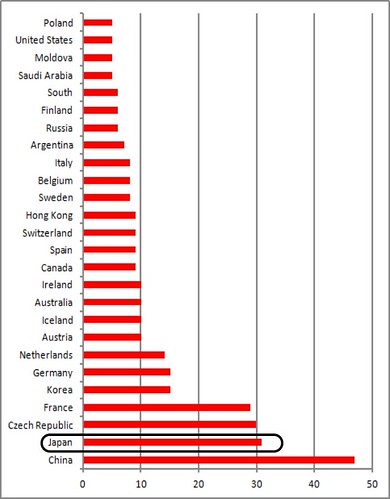
And at least according to Pascal, being religious can be considered to be a sort of insurance for ones soul. In this instance, the Japanese are found to be second only to the the Chinese is in their irreligiousity with 31% of Japanese claiming to be atheists. The Japanese take great care of their bodies, because they can be seen, but a large proportion of them care very much less about their soul since, at least on a naive view, it can't.
Again it should be noted that the Japanese claim to be atheists but involve themselves in a wide range of religio-cultural practices, such as shrine visiting and hiding their thumbs. In other words the Japanese are fairly happy to take risks when it comes to their lack of a linguistic avowal of some sort of creed or religion because no one is listening. But they are risk averse (as I found out with a survey) when it comes to skipping out on a shrine visit to praying for the health of their three, five, and seven year old children. Japanese behaviour thus appears to be paradoxical until one realises that what matters is how things appear, not what people say.
There should be many other linguistic risks that the Japanese take, at least if only by omission.
Image based on data from the Global Index of Religion and Atheism.
Labels: japanese culture, Nacalian, nihonbunka, occularcentrism, psychology, religion, reversal, Shinto, 日本文化
Sexual Risk Taking: Japan is Fairly Safe
The Japanese rate themselves to be the most risk averse nation in the world with more than 70% of Japanese saying that they are NOT someone who enjoys taking risks (World Values Survey). I believe that the differences between Japan and other developed nations are qualitative rather than quantitative so there should be some area of Japanese behaviour in which they are shown to take risks. I think it unlikely that they would say that they enjoy taking risks since this would be similar to standing out in their linguistic self expressions - something that they have no interest in doing.
Eating blowfish and getting on roller coasters are both not very risky behaviours when compared to skydiving (the 5th most dangerous sport after BASE jumping, swimming, cycling and running).
Guzman and Pohlman (2014) highlight the following classes of risky behaviour among youth worldwide: "Self-Injurious Behaviours, Violence, and Suicide, Substance Use, Risky Sexual Behaviour, and Behaviours Related to Obesity and Unhealthy Dieting." Only suicide is clearly elevated in Japan but that is a special case of risky behaviour. I am not sure that self annihilation is actually "taking a risk," but may on the contrary be a way of avoiding risk, and heightening certainty. The only other risky behaviour on that list that might be high in Japan is risky sexual behaviour.
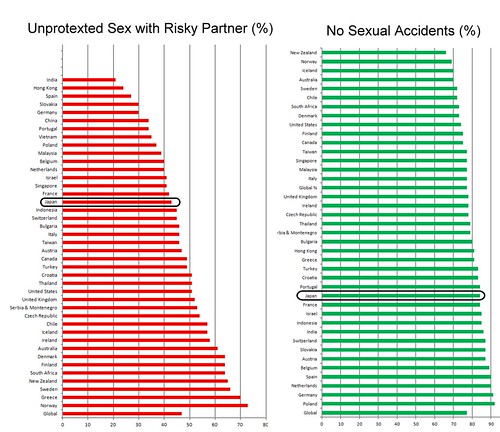
However, Japanese sexual behaviour does not appear to be all that risky. While no where near as risk averse as their self rating would appear to indicate, the Japanese are below the global average (47%) of percent of adults who have had unprotected sex with a person whose sexual history one is unaware at 42%. And the Japanese have better than the global average (77%) of persons who have never had a sexual accident, my term for unwanted pregnancy or sexually transmitted disease, at 84%. Both sets of data are from the Durex World Sex Survey (2005).
So where is Japanese risky behaviour?
Labels: cultural psychology, culture, japanese, japanese culture, nihonbunka, 日本文化
This blog represents the opinions of the author, Timothy Takemoto, and not the opinions of his employer.