
Wednesday, August 17, 2005
Nose Clamp
Thank you to John for recommending this product. This is the best or worst product ever.
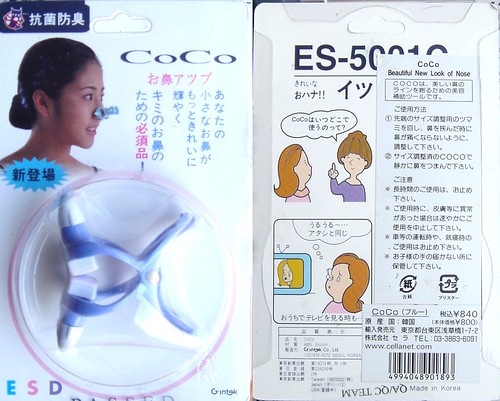
On front
CoCo
Nose Up!
(Anti-bacterial, Anti-odorant. New Release)
Make your little nose shine more beautifully. An essential product for your nose.
On rear (cartoon)
So where and when do you use CoCo?
"Just like me, sniff." thinks a brown haired Asian, wearing a nose clamp, while a watching blonde person on television)
On rear (instruction for use)
1) Adjust the screws at the end so that it does not hurt your nose while clamping.
2) Once you have adjusted the size, quietly (sic. gently) clamp your nose with CoCo.
3) Do not use for long periods of time.
4) Please stop using this device immediately should anything happen to your skin etc.
5) Do not use while driving or sleeping.
6) Keep out of reach of children.
Made in Korea, Imported by Sera in Tokyou, 03-3863-6091
I think that the preference for pointed noses is partly a subliminal effect of watching Western movies. Westernisation through the media helps to foster a creeping racial self-hatred among the not-long-nosed races. In any event, as Kowner (2004) has shown, the more Japanese believe themselves to have traditional Japanese features, the more they believe themselves to be unattractive. Isn't that horribly tragic? If I were Japanese I would feel antipathy towards products like this.
Fortunately, due to Japanese occularcentrism, the Japanese have a far greater tendency to emulate the Western look than the Western mind, but alas, there is a growing tendency to import Western psychology too. Bibliography
Kowner, R. (2004). When Ideals Are Too‘ Far Off’: Physical Self-Ideal Discrepancy and Body Dissatisfaction in Japan. Genetic, social, and general psychology monographs, 130(4), 333–364. Retrieved from http://east-asia.haifa.ac.il/staff/kovner/%2818%29Kowner.2004b.pdf
On front
CoCo
Nose Up!
(Anti-bacterial, Anti-odorant. New Release)
Make your little nose shine more beautifully. An essential product for your nose.
On rear (cartoon)
So where and when do you use CoCo?
"Just like me, sniff." thinks a brown haired Asian, wearing a nose clamp, while a watching blonde person on television)
On rear (instruction for use)
1) Adjust the screws at the end so that it does not hurt your nose while clamping.
2) Once you have adjusted the size, quietly (sic. gently) clamp your nose with CoCo.
3) Do not use for long periods of time.
4) Please stop using this device immediately should anything happen to your skin etc.
5) Do not use while driving or sleeping.
6) Keep out of reach of children.
Made in Korea, Imported by Sera in Tokyou, 03-3863-6091
I think that the preference for pointed noses is partly a subliminal effect of watching Western movies. Westernisation through the media helps to foster a creeping racial self-hatred among the not-long-nosed races. In any event, as Kowner (2004) has shown, the more Japanese believe themselves to have traditional Japanese features, the more they believe themselves to be unattractive. Isn't that horribly tragic? If I were Japanese I would feel antipathy towards products like this.
Fortunately, due to Japanese occularcentrism, the Japanese have a far greater tendency to emulate the Western look than the Western mind, but alas, there is a growing tendency to import Western psychology too. Bibliography
Kowner, R. (2004). When Ideals Are Too‘ Far Off’: Physical Self-Ideal Discrepancy and Body Dissatisfaction in Japan. Genetic, social, and general psychology monographs, 130(4), 333–364. Retrieved from http://east-asia.haifa.ac.il/staff/kovner/%2818%29Kowner.2004b.pdf
Labels: japan, japanese culture, nihonbunka, westernisation, 日本文化


Dead Cicada
According to the Japanese neuroscientist, Tadanobu Tsunoda (1978), the Japanese use the that part of the brain which is used to process language in Westerners, to listen to the sound of cicadas and other insects. The neuroscientist concluded that the Japanese detect meaning (such as the end of the summer, or the heat of the day) in these sound and are thus processing these sounds linguistically.
There are problems with the results and this interpretation.
Other scientists have not been able to replicate the results, which remain highly controversial (Dale, 2011).
The fact that the sound of cicadas is processed by the part of the brain that is processing language in Westerners can be interpreted to mean at least one of two things
1) The sound of cicada's like the other sounds processed in this area are being interpreted linguistically.
2) The sound of cicada's like other sounds including linguistic phonemes are being interpreted like insect sounds, as sounds rather than signs.
I propose the second, more radical interpretation, that Japanese have a tendency to NOT process sounds linguistically. Thus when you talk to a Japanese person, they may be listening to the a-linguistic, purely phonic content of your speech.
And there is research to show that this is in fact the case (Ishii, 2003). Using a emotion word, versus emotive tone of voice Stroop test, where subjects are made to listen to
1) Someone saying "I am happy" in a cheerful tone of voice
2) Someone saying "I am sad" in a sad tone of voice
3) Someone saying "I am happy" in a sad tone of voice.
4) Someone saying "I am sad" in a happy tone of voice.
In the channel-conflicted 'Stroop' conditions, subjects are likely to make mistakes, or pause before they are able to recognise the meaning of the sentence being spoken. Japanese subjects, much more than Americans, were likely to listen and be swayed by the emotive content of the voice, rather than the linguistic meaning of the words. In a sense the Japanese are listening to the words as if they are the chirping sound of cicada.
Bibliography
Dale, P. (2011). Myth of Japanese Uniqueness (1st ed.). Routledge.
Ishii, K., Reyes, J. A., & Kitayama, S. (2003). Spontaneous Attention to Word Content Versus Emotional Tone. Psychological Science, 39–46. Retrieved from http://php.scripts.psu.edu/users/n/x/nxy906/COMPS/indivdualismandcollectivism/culture%20lit/to%20print/Kitayma2003threecultures.pdf
Tsunoda, T. 角田忠信. (1978). 日本人の脳―脳の働きと東西の文化. 大修館書店.

There are problems with the results and this interpretation.
Other scientists have not been able to replicate the results, which remain highly controversial (Dale, 2011).
The fact that the sound of cicadas is processed by the part of the brain that is processing language in Westerners can be interpreted to mean at least one of two things
1) The sound of cicada's like the other sounds processed in this area are being interpreted linguistically.
2) The sound of cicada's like other sounds including linguistic phonemes are being interpreted like insect sounds, as sounds rather than signs.
I propose the second, more radical interpretation, that Japanese have a tendency to NOT process sounds linguistically. Thus when you talk to a Japanese person, they may be listening to the a-linguistic, purely phonic content of your speech.
And there is research to show that this is in fact the case (Ishii, 2003). Using a emotion word, versus emotive tone of voice Stroop test, where subjects are made to listen to
1) Someone saying "I am happy" in a cheerful tone of voice
2) Someone saying "I am sad" in a sad tone of voice
3) Someone saying "I am happy" in a sad tone of voice.
4) Someone saying "I am sad" in a happy tone of voice.
In the channel-conflicted 'Stroop' conditions, subjects are likely to make mistakes, or pause before they are able to recognise the meaning of the sentence being spoken. Japanese subjects, much more than Americans, were likely to listen and be swayed by the emotive content of the voice, rather than the linguistic meaning of the words. In a sense the Japanese are listening to the words as if they are the chirping sound of cicada.
Bibliography
Dale, P. (2011). Myth of Japanese Uniqueness (1st ed.). Routledge.
Ishii, K., Reyes, J. A., & Kitayama, S. (2003). Spontaneous Attention to Word Content Versus Emotional Tone. Psychological Science, 39–46. Retrieved from http://php.scripts.psu.edu/users/n/x/nxy906/COMPS/indivdualismandcollectivism/culture%20lit/to%20print/Kitayma2003threecultures.pdf
Tsunoda, T. 角田忠信. (1978). 日本人の脳―脳の働きと東西の文化. 大修館書店.
Labels: japan, japanese culture, nihonbunka, 日本文化
This blog represents the opinions of the author, Timothy Takemoto, and not the opinions of his employer.